


Digital Door Lock System Market Set for Rapid Growth Through 2034 with Rising Demand for Smart Access Control
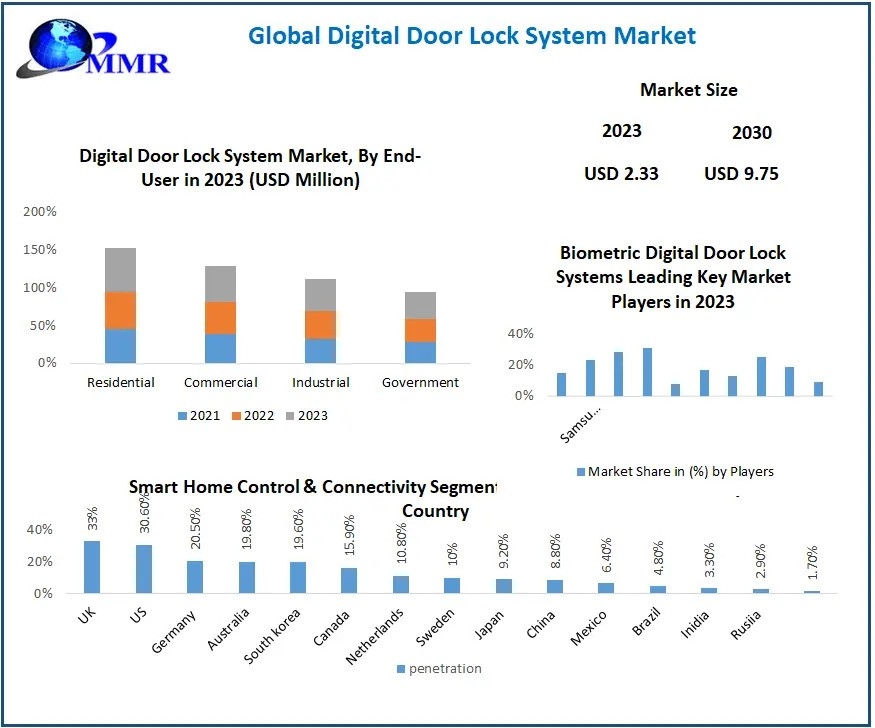
Digital Door Lock System Market to Reach USD 11.37 Billion by 2034, Growing at 15.5% CAGR as Smart Security Adoption Accelerates
Global Digital Door Lock System Market Growth Driven by Smart Home Expansion, Biometric Authentication, Keyless Access Technology, and Increasing Investment in Connected Building Security
The global Digital Door Lock System Market is entering a period of significant technological and commercial expansion as consumers, property developers, and businesses increasingly adopt intelligent security solutions. According to Maximize Market Research, the market was valued at USD 3.11 billion in 2025 and is projected to reach approximately USD 11.37 billion by 2034, registering a compound annual growth rate (CAGR) of 15.5% during 2026–2034.
Rising demand for keyless entry, remote access management, biometric identification, and integrated smart home technologies is transforming the traditional door security industry. Digital locking systems are evolving from standalone security products into connected access management solutions that support convenience, monitoring, and operational efficiency.
Residential buildings, commercial offices, hospitality establishments, and institutional facilities are increasingly evaluating digital locks to modernize security infrastructure and simplify access administration.
The industry's development creates opportunities for electronic component manufacturers, smart security companies, software developers, property management businesses, and technology investors.
As digital transformation accelerates, market participants are prioritizing secure connectivity, system reliability, interoperability, and customer-focused product innovation to strengthen their competitive positions.
Digital Door Lock System Market Outlook: Smart Security Becomes an Essential Building Technology
The growing adoption of connected security technologies is changing how homeowners and organizations manage physical access.
Traditional mechanical locks rely primarily on physical keys, while digital door locks can incorporate electronic authentication, programmable credentials, remote monitoring, and automated access permissions.
These capabilities are increasingly important in buildings where multiple individuals require controlled entry.
Homeowners can manage access through smartphones, temporary codes, or biometric credentials, while commercial organizations can use electronic locking systems to simplify employee and visitor management.
The market's growth reflects increasing interest in technologies that connect physical building infrastructure with digital management platforms.
For manufacturers, future opportunities extend beyond selling individual locks. Businesses can develop comprehensive security ecosystems combining hardware, mobile applications, installation services, technical support, and access management software.
This transition is encouraging companies to strengthen their product portfolios and establish long-term relationships with property developers, distributors, and building technology providers.
Sustainable growth will depend on delivering dependable security functionality rather than relying solely on connected features.
𝐃𝐨𝐰𝐧𝐥𝐨𝐚𝐝 𝐏𝐃𝐅 𝐁𝐫𝐨𝐜𝐡𝐮𝐫𝐞 @
https://www.maximizemarketresearch.com/request-sample/15375/
Rising Smart Home Adoption Drives Demand for Digital Door Lock Systems
Increasing adoption of smart home technologies is a major factor supporting the Digital Door Lock System Market.
Consumers are becoming more familiar with connected devices, including smart lighting, surveillance cameras, intelligent thermostats, and automated home management systems.
Digital door locks are increasingly being considered part of this connected environment because they allow users to manage entry permissions and receive security-related notifications.
Smartphone-enabled systems provide convenient alternatives to carrying physical keys, particularly for households managing multiple users or frequently changing access requirements.
Integration with compatible smart home platforms also allows users to coordinate door locking with other connected devices.
For example, automated routines can support locking schedules, occupancy-based notifications, and selected security responses.
Property developers are evaluating these capabilities when planning premium residential projects and modern apartment complexes.
The commercial opportunity is particularly relevant for manufacturers offering reliable products that integrate with commonly used consumer technology platforms.
Companies capable of simplifying installation, improving mobile application usability, and supporting multiple authentication methods may gain an advantage in competitive residential markets.
Biometric Authentication and Keyless Entry Technologies Reshape Product Innovation
Biometric technologies are becoming increasingly important in the development of advanced digital locking solutions.
Fingerprint recognition is widely used because it offers convenient authentication without requiring users to remember passwords or carry physical credentials.
Other approaches include facial recognition, palm-based authentication, and additional biometric identification technologies.
These systems can improve usability, although their effectiveness depends on sensor accuracy, implementation quality, and suitable security safeguards.
Manufacturers are also introducing multiple authentication methods within individual products, allowing users to select fingerprints, passwords, mobile credentials, or mechanical backup keys.
Such flexibility supports different consumer preferences and operational requirements.
Keyless technology is also expanding through near-field communication, Bluetooth connectivity, radio-frequency identification, and smartphone-based digital credentials.
For businesses, these innovations create opportunities to develop differentiated products for residential, commercial, and hospitality applications.
However, successful product development must balance convenience with secure authentication, privacy protection, battery reliability, and emergency access requirements.
Manufacturers investing in dependable electronics and practical security architecture are better positioned to establish long-term customer confidence.
Commercial Buildings and Hospitality Facilities Create New Revenue Opportunities
Digital access systems are becoming increasingly relevant in commercial property management and hospitality operations.
Office buildings require controlled access for employees, contractors, visitors, and service personnel. Electronic locks can support centralized credential administration and reduce dependence on physical key distribution.
Hotels can benefit from digital access technologies that support guest check-in processes, temporary credentials, and room access management.
When integrated appropriately with property management platforms, electronic locking systems can help reduce administrative work associated with issuing and replacing traditional keys.
Multifamily residential properties and managed rental accommodation also represent important opportunities.
Property managers can use digital access systems to manage tenant turnover and coordinate authorized maintenance access.
For technology providers, commercial demand creates opportunities for larger installations, system integration, recurring support contracts, and equipment replacement programs.
Suppliers must nevertheless evaluate reliability, access continuity, emergency procedures, and compatibility with existing building infrastructure.
Organizations capable of delivering complete installation and maintenance services can strengthen customer retention while creating additional revenue beyond initial equipment sales.
Cybersecurity and Product Reliability Remain Critical Market Challenges
Despite attractive growth prospects, the Digital Door Lock System Market faces challenges related to cybersecurity, equipment costs, technical compatibility, and user confidence.
Connected locks can introduce digital attack surfaces involving wireless communications, authentication credentials, mobile applications, and cloud-based infrastructure.
Inadequately secured systems may expose users to unauthorized access attempts or privacy risks.
As a result, manufacturers must prioritize secure product design, encrypted communications, software maintenance, and effective vulnerability management.
Battery performance is another important consideration because some digital locks depend on internal power sources.
Buyers must evaluate low-battery warnings, emergency power options, mechanical overrides where appropriate, and procedures for maintaining access during technical failures.
Compatibility challenges can also arise when products use different wireless protocols or proprietary software systems.
For manufacturers, these issues create opportunities to differentiate through transparent security practices, dependable customer support, and longer product support lifecycles.
Businesses that invest in reliable engineering and responsible cybersecurity management can develop stronger customer relationships and reduce operational risks.
Digital Door Lock System Market Segmentation: Biometric and Connected Locks Expand Product Choices
The Digital Door Lock System Market is segmented by product type, lock type, access control type, end-user industry, and geography.
By Product Type: Major categories include biometric locks, RFID/NFC-based locks, password-based locks, Bluetooth/Wi-Fi-enabled smart locks, and other electronic locking systems.
Biometric locks are important for consumers seeking convenient identification, while smartphone-enabled systems support remote management and integration with connected devices.
RFID and NFC solutions remain relevant in hospitality, institutional, and commercial environments where contactless credentials are widely used.
By Lock Type: The market includes mortise locks, cylindrical locks, rim locks, padlocks, and other configurations.
Product selection depends on door construction, installation requirements, security expectations, and replacement compatibility.
By Access Control Type: The market covers single-point access, multi-point access, and remote access control.
Remote access solutions are commercially attractive for managed properties because they support digital administration across different locations.
By End-User Industry: Applications include residential homes and apartments, commercial buildings and offices, hospitality and hotels, government and public infrastructure, and other facilities.
These segments offer different opportunities for manufacturers, distributors, and system integrators seeking to develop targeted business strategies.
North America Leads the Digital Door Lock System Market
North America is expected to maintain a leading position throughout the forecast period, supported by established smart home adoption, consumer purchasing power, and demand for modern building security technologies.
The United States represents an important market because of its connected device ecosystem and mature residential technology distribution networks.
Consumer awareness of smartphone-controlled devices supports opportunities for smart lock manufacturers and home automation providers.
Commercial property operators are also evaluating electronic access solutions to simplify building management.
Canada contributes additional demand through residential modernization, institutional security applications, and commercial building technology investments.
For manufacturers, North America provides opportunities in product upgrades, replacement demand, connected home partnerships, and advanced access control systems.
However, market competition requires suppliers to emphasize installation convenience, security reliability, customer experience, and long-term product support.
Europe Digital Door Lock System Market Benefits from Building Modernization
Europe represents an important market for electronic security technology, supported by established access control manufacturers and increasing interest in connected building infrastructure.
Germany, the United Kingdom, France, Italy, Spain, and other European countries offer opportunities across residential and commercial applications.
Demand is influenced by building renovation, property security requirements, hospitality technology investment, and interest in interoperable smart home devices.
European buyers may place particular emphasis on product quality, privacy protection, compliance, and compatibility with existing building hardware.
Manufacturers entering the region must account for differences in door standards, installation practices, and distribution arrangements.
Strategic partnerships with local security specialists and building technology integrators can improve market access.
For established suppliers, product modernization and secure software integration provide opportunities to strengthen competitive positioning.
Asia Pacific Offers Significant Long-Term Expansion Opportunities
Asia Pacific presents substantial opportunities for the Digital Door Lock System Market as urban development, residential construction, and consumer technology adoption support demand.
China, India, Japan, and South Korea are important countries for evaluating product manufacturing, distribution, and consumer adoption strategies.
Increasing smartphone penetration and familiarity with electronic security products encourage interest in connected locking systems.
In large residential developments, property management requirements may create opportunities for standardized digital access installations.
Hotels, offices, and managed accommodation facilities also represent potential sources of demand.
Manufacturers can improve competitiveness through localized pricing, dependable installation networks, and products suitable for regional building requirements.
However, differences in purchasing power and distribution infrastructure require carefully designed market entry strategies.
Companies that balance affordability with dependable security capabilities may benefit from the region's long-term development.
Competitive Landscape: Manufacturers Focus on Connectivity and Security Innovation
Competition within the Digital Door Lock System Market includes established security manufacturers, electronic hardware specialists, and emerging smart home technology companies.
Important participants identified in the market include ASSA ABLOY, August Home, Yale, Schlage, Allegion, dormakaba, Kwikset, SALTO Systems, Honeywell, MIWA Lock, and Cansec Systems.
Companies compete through product reliability, authentication technology, connectivity, installation compatibility, customer support, and distribution capabilities.
Established manufacturers benefit from existing relationships with locksmiths, contractors, commercial property operators, and security distributors.
Technology-focused companies may differentiate through mobile applications, wireless connectivity, and connected home integration.
Strategic acquisitions, distribution partnerships, and technology development can support expansion into additional customer segments.
For equipment buyers, long-term maintenance support and software security increasingly influence procurement decisions.
Manufacturers that combine reliable mechanical engineering with effective digital technology are likely to maintain stronger competitive positions.
Recent Developments Demonstrate Rapid Smart Lock Innovation
Recent product developments highlight increasing investment in advanced authentication and connectivity technologies.
In January 2025, Schlage introduced its Sense Pro Smart Deadbolt concept, featuring Ultra Wideband technology and Matter-over-Thread connectivity.
During the same month, ULTRALOQ presented smart locking products incorporating UWB, NFC, and connected home compatibility.
In October 2025, ULTRALOQ announced wider availability of its Bolt Z-Wave smart lock, expanding options for connected residential installations.
In January 2026, Lockin presented its V7 Max system with wireless optical charging technology and multiple biometric authentication capabilities.
Aqara also introduced its Smart Lock U400 in January 2026, highlighting the growing emphasis on proximity-based digital access.
These developments illustrate how manufacturers are competing through usability, interoperability, and new authentication capabilities.
Commercial success will ultimately depend on product reliability, security performance, consumer acceptance, and effective distribution.
Emerging Trends Transform the Future of Connected Door Security
Several technological trends are expected to influence the digital locking industry through 2034.
Ultra Wideband Technology: UWB-based proximity detection can support hands-free unlocking when compatible devices are authenticated and appropriately positioned.
Smart Home Interoperability: Compatibility with connected home platforms may reduce integration barriers and improve consumer convenience.
Multi-Factor Authentication: Combining authentication methods can strengthen access management for selected high-security applications.
Cloud-Based Access Administration: Commercial property operators can manage permissions and review access events through centralized platforms.
Mobile Digital Credentials: Smartphone-based credentials are creating alternatives to traditional physical keys and access cards.
Energy-Efficient Hardware: Improved battery management and alternative power technologies can reduce maintenance requirements.
These developments demonstrate that the industry is moving toward integrated security solutions combining physical protection with software-based management.
Strategic Investment Opportunities and Future Business Decisions
The expanding Digital Door Lock System Market creates opportunities for hardware manufacturers, semiconductor suppliers, software developers, distributors, and building technology companies.
Manufacturers should prioritize durable product design, secure connectivity, authentication flexibility, and compatibility with established door hardware.
Software businesses can develop secure credential management, access administration, and property management integrations.
System integrators can expand their offerings through installation, maintenance, technical support, and building security modernization services.
Investors evaluating market opportunities should consider product development costs, cybersecurity obligations, customer acquisition expenses, and recurring support requirements.
For property developers, digital access investments should be assessed against installation costs, operating requirements, security benefits, and lifecycle maintenance expenditure.
Companies seeking international expansion must evaluate regional building standards, consumer affordability, technical service networks, and regulatory requirements.
The strongest business opportunities are likely to emerge where reliable hardware, secure software, and practical customer needs intersect.
Future Outlook: Digital Security Becomes an Integrated Building Service
The projected expansion of the Digital Door Lock System Market to USD 11.37 billion by 2034 reflects growing interest in intelligent access management across residential, commercial, and institutional environments.
Future development will increasingly focus on interoperability, cybersecurity, convenient authentication, and dependable product performance.
Manufacturers must continue investing in innovation while maintaining mechanical reliability and long-term software support.
Property owners and organizations will increasingly evaluate digital locks as part of broader building security and operational management strategies.
For investors, sustained growth depends on identifying companies capable of turning technological improvements into commercially viable solutions.
Businesses that combine responsible innovation with effective distribution, reliable service, and clear customer value will be better positioned to capitalize on expanding global demand.
𝐃𝐨𝐰𝐧𝐥𝐨𝐚𝐝 𝐏𝐃𝐅 𝐁𝐫𝐨𝐜𝐡𝐮𝐫𝐞 @
https://www.maximizemarketresearch.com/market-report/global-digital-door-lock-system-market/15375/
About Maximize Market Research
Maximize Market Research publishes sector forecasts, competitive analysis, and consulting insight for teams evaluating demand, competition, pricing, and growth strategy across high-value industries.
The company provides research and consulting services designed to help businesses understand changing industry conditions, identify investment opportunities, evaluate competition, and develop informed growth strategies.
Its research coverage includes technology, electronics, industrial automation, healthcare, consumer products, energy, manufacturing, and other important global industries.
Through research-driven analysis and market intelligence, Maximize Market Research supports strategic planning, competitive benchmarking, market entry decisions, and business expansion initiatives.
Contact Information
MAXIMIZE MARKET RESEARCH PVT. LTD.
2nd Floor, Navale IT Park Phase 3
Pune Banglore Highway, Narhe
Pune, Maharashtra 411041, India
Phone: +91 9607365656
Email: sales@maximizemarketresearch.com
Website: https://www.maximizemarketresearch.com/
Read the Complete Digital Door Lock System Market Report:
https://www.maximizemarketresearch.com/market-report/global-digital-door-lock-system-market/15375/

