


How Do Turnkey Modular IVF Lab Solutions Support Future-Ready Fertility Laboratories?
Introduction
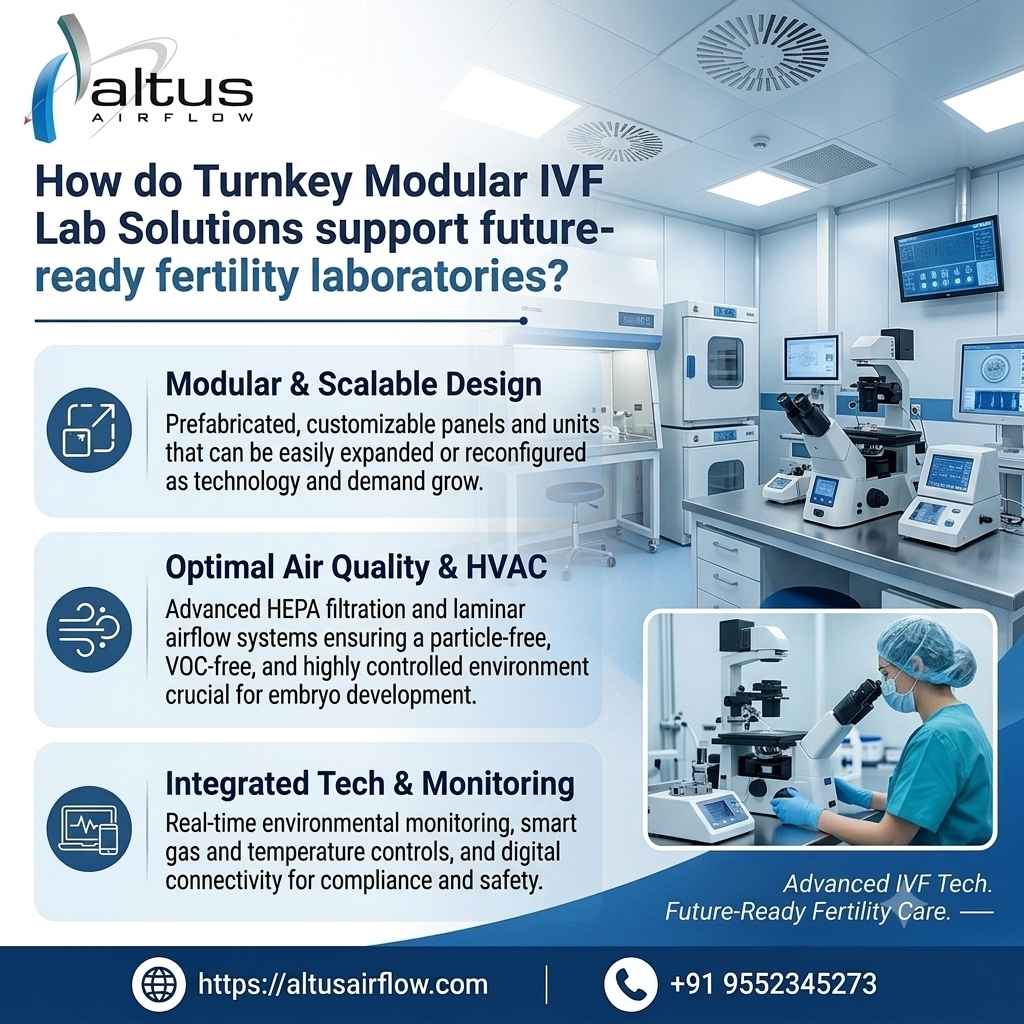
Altus Airflow focuses on developing modern healthcare infrastructure that supports the evolving requirements of fertility centres. Turnkey Modular IVF Lab Solutions provide an integrated approach to laboratory development by combining planning, modular construction, HVAC systems, electrical provisions, equipment coordination, and installation under a coordinated project framework. This approach helps fertility clinics establish organized laboratory environments while reducing coordination challenges and supporting efficient project execution.
As fertility treatments continue to advance, laboratories require adaptable infrastructure, reliable environmental controls, and layouts that accommodate modern equipment. A future-ready laboratory should support current clinical activities while allowing scope for technological upgrades and operational growth.
1. Understanding the Concept of Future-Ready IVF Laboratories
A future-ready IVF laboratory is designed to accommodate changing clinical requirements, evolving technologies, and increasing operational demands. It should provide an organized environment for embryologists while supporting the precise conditions required for sensitive laboratory procedures.
Traditional laboratory development may involve coordinating several independent contractors for construction, ventilation, electrical work, and equipment installation. This can create communication gaps and increase the possibility of design conflicts.
An integrated project approach helps bring these activities together under a coordinated plan. It considers the complete laboratory environment rather than treating individual systems as separate installations.
Important objectives include:
-
Creating efficient laboratory layouts.
-
Supporting controlled environmental conditions.
-
Integrating specialized medical equipment.
-
Improving space utilization.
-
Providing organized utility connections.
-
Allowing future infrastructure modifications.
-
Supporting maintenance and operational efficiency.
This planning approach helps fertility centres prepare their laboratories for both present and future requirements.
2. Providing Customized Laboratory Design and Planning
Every fertility centre has different operational needs. The number of embryologists, treatment capacity, available floor area, equipment requirements, and clinical workflow influence laboratory design.
Customized planning begins with discussions involving fertility specialists, embryologists, architects, biomedical engineers, and infrastructure professionals.
The design team evaluates the available space and identifies suitable locations for different laboratory activities.
Common laboratory areas may include:
-
Embryology workstations.
-
Oocyte handling areas.
-
Micromanipulation sections.
-
Sperm preparation rooms.
-
Cryopreservation areas.
-
Equipment storage spaces.
-
Laboratory utility sections.
The layout should support logical movement between workstations and reduce unnecessary handling of samples and materials.
Equipment positioning must also be considered during the design stage. Incubators, microscopes, laminar airflow workstations, and other instruments require suitable space, electrical connections, and access for maintenance.
A customized layout helps avoid overcrowding and supports efficient daily operations.
3. Supporting Advanced HVAC and Environmental Control
Environmental stability is a major consideration in IVF laboratory planning. Sensitive reproductive materials require carefully managed laboratory conditions, making ventilation and environmental monitoring important infrastructure elements.
A future-ready laboratory should have an HVAC system designed according to its intended use, applicable standards, and project-specific requirements.
Important HVAC considerations include:
Air filtration: Appropriate filtration systems help control airborne particles. HEPA filters may be incorporated where required by the laboratory design.
Temperature regulation: Temperature management supports stable working conditions and helps accommodate the environmental requirements of laboratory equipment.
Humidity control: Humidity should be maintained within the specified range based on laboratory activities and equipment requirements.
Air pressure management: Suitable pressure relationships between laboratory areas can form part of the contamination-control strategy.
Airflow distribution: Supply and return air arrangements should be designed to support the intended airflow pattern and minimize unwanted turbulence.
Environmental monitoring systems can help laboratory teams observe important operating parameters. Appropriate testing and commissioning should verify that the installed HVAC system performs according to approved specifications.
4. Enabling Integration of Modern Laboratory Equipment
Technological advancements continue to influence fertility treatment and embryology procedures. Modern laboratories may require specialized instruments that need precise positioning, reliable utilities, and suitable operating environments.
Infrastructure planning should consider equipment requirements before modular construction begins.
Common equipment includes:
-
IVF incubators.
-
Inverted microscopes.
-
Micromanipulation systems.
-
Laminar airflow workstations.
-
Cryopreservation equipment.
-
Laboratory refrigerators and freezers.
-
Temperature and environmental monitoring devices.
Each instrument may have specific requirements related to dimensions, electrical supply, ventilation, connectivity, and maintenance access.
For example, incubators need appropriate power connections and suitable positioning. Micromanipulation systems require stable work surfaces and carefully organized workstation arrangements.
Coordination with equipment suppliers and biomedical professionals helps prevent installation conflicts. It also makes it easier to accommodate additional instruments if the laboratory expands in the future.
5. Improving Workflow Through Intelligent Space Utilization
An efficient laboratory layout can improve staff movement and make routine procedures more organized.
Workflow planning should consider how embryologists move between workstations, handle samples, access equipment, and complete documentation.
Poorly organized layouts may lead to unnecessary movement, overcrowded work areas, and difficulties accessing essential instruments.
A well-planned laboratory can address these challenges through:
Dedicated work zones: Assigning suitable areas for different procedures helps maintain an organized environment.
Accessible equipment placement: Frequently used instruments should be positioned conveniently without obstructing other activities.
Organized storage: Consumables, laboratory supplies, and accessories should have designated storage locations.
Clear movement paths: Workstation arrangements should allow personnel to move safely and efficiently.
Appropriate work surfaces: Laboratory furniture should support the dimensions and operating requirements of specialized equipment.
Workflow planning should always be reviewed with the actual laboratory users. Their feedback helps ensure that the proposed arrangement is practical for daily activities.
6. Using Modular Construction for Adaptability
Modular construction offers flexibility in developing laboratory interiors according to approved design requirements.
Instead of relying entirely on conventional construction methods, modular components can be manufactured and assembled to suit the planned laboratory layout.
Typical components include wall panels, ceiling systems, doors, flooring, and laboratory furniture.
The main advantage of modular construction is that it allows infrastructure elements to be planned as part of an integrated system.
For future-ready laboratories, adaptability is particularly valuable. A fertility centre may need to modify its workstation arrangement, introduce new equipment, or reorganize certain areas as its services develop.
Modular systems can make selected modifications more manageable, depending on the original design and the nature of the proposed changes.
Material selection is equally important. Smooth, durable, non-porous, and easy-to-clean surfaces are generally preferred for controlled laboratory environments.
The specifications should be evaluated according to hygiene requirements, cleaning procedures, durability, and compatibility with laboratory operations.
7. Supporting Digital Integration and Environmental Monitoring
Digital technologies are becoming increasingly relevant to modern laboratory management.
Future-ready infrastructure should consider how monitoring devices, data connections, and equipment interfaces can be incorporated into the laboratory design.
Environmental monitoring systems may help staff observe parameters such as:
-
Temperature.
-
Relative humidity.
-
Differential air pressure.
-
Selected equipment operating conditions.
-
Alarm and system status information.
Where required, monitoring arrangements can be designed to provide alerts when specified environmental conditions move outside approved limits.
Digital integration also requires proper planning for electrical outlets, data connections, cable pathways, and equipment communication requirements.
The infrastructure team should coordinate with technology suppliers to understand the compatibility requirements of the proposed systems.
Importantly, digital monitoring does not replace routine inspections, calibration, equipment maintenance, or established laboratory quality procedures. It provides an additional layer of operational visibility.
8. Improving Project Coordination and Execution
Developing a modern IVF laboratory involves several interconnected activities. These may include architectural planning, modular manufacturing, HVAC installation, electrical work, equipment procurement, and commissioning.
If these activities are managed independently without proper coordination, project delays and technical conflicts may occur.
A coordinated project framework helps establish clear responsibilities and execution milestones.
The typical process includes:
-
Initial consultation and requirement analysis.
-
Site assessment and feasibility evaluation.
-
Laboratory layout development.
-
Design review and approval.
-
Material selection and procurement.
-
Modular component manufacturing.
-
Site preparation and installation.
-
HVAC and electrical integration.
-
Laboratory equipment coordination.
-
Testing, commissioning, and handover.
Regular progress meetings help identify potential problems before they affect subsequent activities.
Clear documentation also supports communication between the hospital, infrastructure provider, contractors, and equipment suppliers.
9. Supporting Quality Control and Regulatory Preparedness
Quality control is essential when developing specialized fertility laboratory infrastructure.
A future-ready facility should be planned with attention to applicable healthcare requirements, laboratory procedures, and relevant technical standards.
Quality checks should be performed throughout the project rather than being restricted to the final inspection.
Important activities include:
Material verification: Confirm that modular components meet the approved specifications.
Installation inspection: Review panel alignment, joints, sealing, flooring, and finishing.
HVAC testing: Evaluate airflow, temperature, humidity, pressure relationships, and filtration performance as applicable.
Electrical inspection: Verify wiring, earthing, protective devices, and designated backup power arrangements.
Equipment checks: Confirm installation conditions and functional performance according to manufacturer instructions.
Documentation: Maintain installation records, testing reports, equipment manuals, and relevant certificates.
Hospitals should also assess the applicable accreditation and regulatory requirements for their facility. Infrastructure design and commissioning should support these requirements, but accreditation depends on broader clinical, operational, and quality-management practices.
10. Making Space for Future Expansion and Technology Upgrades
Fertility centres may expand their treatment capacity or introduce new laboratory technologies over time. Infrastructure that is designed only for immediate requirements may become difficult to modify later.
Future expansion should therefore be considered during the initial planning stage.
Some useful provisions include:
-
Adequate space for additional equipment.
-
Accessible utility connections.
-
Planned cable and service routes.
-
Flexible workstation arrangements.
-
Suitable electrical capacity.
-
Accessible maintenance zones.
-
Space for additional storage.
-
Infrastructure provisions for monitoring upgrades.
These considerations can reduce the need for extensive modifications when operational requirements change.
However, future expansion should not compromise environmental controls, workflow separation, or laboratory safety. Any modification must be reviewed by qualified professionals and tested before the affected areas are used.
11. Reducing Maintenance Challenges and Supporting Long-Term Performance
A future-ready laboratory should be convenient to maintain throughout its operational life.
Infrastructure components should be selected with attention to durability, cleaning requirements, service access, and replacement needs.
For example, HVAC equipment should have suitable access for inspection and filter maintenance. Electrical systems should be organized so that faults can be identified and addressed safely.
Modular wall and ceiling systems should also be designed to support appropriate inspection and maintenance activities.
A planned maintenance programme may include:
-
Regular HVAC inspections.
-
Filter replacement according to specifications.
-
Environmental sensor calibration.
-
Electrical safety checks.
-
Inspection of modular panels and joints.
-
Equipment servicing.
-
Review of monitoring and alarm systems.
Proper handover documentation helps hospital teams understand the installed systems and follow recommended maintenance procedures.
12. Choosing the Right Project Partner
The selection of an experienced infrastructure partner can influence the overall quality and coordination of an IVF laboratory project.
Fertility centres should evaluate potential providers based on their technical capabilities, project planning methods, material specifications, installation experience, and support arrangements.
Important factors to consider include:
-
Understanding of IVF laboratory requirements.
-
Ability to prepare customized layouts.
-
Knowledge of modular construction systems.
-
HVAC and environmental control planning.
-
Coordination with equipment suppliers.
-
Quality inspection procedures.
-
Project scheduling and documentation.
-
Commissioning and maintenance support.
Hospitals should also review technical proposals carefully and ensure that the scope of work clearly identifies responsibilities, specifications, exclusions, and deliverables.
Choosing a suitable partner helps establish a more predictable project process and supports the development of infrastructure aligned with the fertility centre's long-term goals.
Conclusion
Future-ready fertility laboratories require more than modern interiors. They need carefully planned layouts, reliable environmental controls, adaptable modular infrastructure, coordinated equipment integration, and systematic quality management. A well-executed project can help fertility centres accommodate evolving technologies, improve workflow organization, and prepare for future operational requirements.
Altus Airflow focuses on coordinated healthcare infrastructure planning and modular laboratory development to support these objectives. By implementing Turnkey Modular IVF Lab Solutions, Altus Airflow helps fertility centres plan integrated laboratory environments that address current requirements while providing a foundation for future upgrades and long-term operational efficiency.
Frequently Asked Questions (FAQs)
1. How do Turnkey Modular IVF Lab Solutions support future-ready fertility laboratories?
Turnkey Modular IVF Lab Solutions support future-ready laboratories through integrated planning, modular construction, HVAC systems, equipment coordination, digital monitoring provisions, and adaptable infrastructure.
2. Why is modular construction useful for IVF laboratories?
Modular construction supports customized layouts, organized installation, easier maintenance planning, and selected future modifications.
3. What role does HVAC play in a future-ready IVF laboratory?
HVAC systems help manage filtration, temperature, humidity, and airflow according to the laboratory's specified environmental requirements.
4. Can an IVF laboratory accommodate future equipment upgrades?
Yes. Advance planning for space, electrical capacity, utility connections, and service access can make future equipment upgrades more manageable.
5. Why is equipment integration important during laboratory planning?
Early equipment integration helps ensure suitable positioning, utility connections, accessibility, and compatibility with the laboratory layout.
Read Our Previous Blog ---------------> How does a Modular IVF Lab Setup Company ensure seamless project execution?

