


3D Stacking Market CAGR: Analyzing Growth Trajectory and Future Prospects
Growth Trajectory and CAGR Analysis
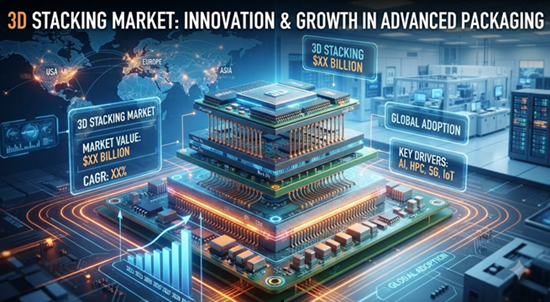
The 3D Stacking Market CAGR reflects the robust expansion trajectory of this transformative semiconductor packaging sector, demonstrating sustained momentum as manufacturers increasingly recognize the necessity of vertical integration for meeting modern performance requirements. Understanding the factors driving this impressive growth provides valuable insights for stakeholders seeking to capitalize on emerging opportunities within the advanced packaging technology landscape. The compound annual growth rate observed across the market underscores the fundamental shift occurring within semiconductor manufacturing, where 3D stacking has transitioned from specialized technology to essential capability for competitive product development. This growth analysis examines the multifaceted drivers, technology trends, and application dynamics that collectively shape the market's remarkable expansion trajectory and create opportunities for value creation across the semiconductor ecosystem.
Artificial Intelligence Demand Accelerating Market Expansion
Artificial intelligence and machine learning applications represent a primary growth catalyst within the 3D stacking market, driving unprecedented demand for high-bandwidth memory and advanced logic devices. AI accelerators require massive memory bandwidth to feed computational engines performing complex neural network operations, requirements that stacked memory solutions uniquely address. The proliferation of AI applications across industries including healthcare, financial services, autonomous vehicles, and consumer electronics creates sustained demand for increasingly sophisticated semiconductor solutions. Data centers supporting AI workloads invest heavily in advanced packaging technologies that enable higher performance within power and space constraints. Edge AI applications in smartphones, cameras, and IoT devices require compact, energy-efficient solutions that 3D stacking provides. As AI capabilities expand and model complexity increases, the demand for stacked semiconductor solutions continues growing, creating durable market expansion drivers.
5G Infrastructure Deployment Driving Component Demand
The global deployment of 5G telecommunications infrastructure represents a significant growth catalyst for the 3D stacking market, as network equipment requires high-performance semiconductor components that leverage advanced packaging technologies. 5G base stations, antennas, and supporting infrastructure demand components that deliver high performance within compact, energy-efficient packages suitable for distributed deployment. Radio frequency front-end modules benefit from 3D stacking approaches that integrate multiple functions while maintaining signal integrity. The expansion of 5G networks continues globally, creating sustained demand for telecommunications components that address the unique requirements of high-frequency, high-bandwidth communication systems. Future network evolution including 5G-Advanced and eventual 6G development will continue driving demand for advanced semiconductor solutions that 3D stacking enables, creating a durable growth trajectory for the market.
Consumer Electronics Innovation Sustaining Market Momentum
Consumer electronics innovation represents a substantial and growing demand driver within the 3D stacking market, with manufacturers continuously seeking ways to deliver enhanced functionality within increasingly compact devices. Smartphones, tablets, wearables, and other personal devices require semiconductor solutions that balance performance, power efficiency, and space constraints. Stacked memory configurations enable manufacturers to increase capacity and bandwidth without proportionally increasing device thickness, addressing consumer preferences for sleek, portable designs. Advanced packaging technologies enable integration of multiple functions within single packages, reducing component counts and simplifying device assembly. The continued evolution of consumer electronics toward more capable, connected, and intelligent devices sustains demand for the performance improvements that 3D stacking provides. This application segment represents a foundational market driver that will continue supporting growth regardless of broader economic conditions.
Strategic Implications for Stakeholders Navigating Market Growth
The growth trajectory of the 3D stacking market creates significant strategic implications for various stakeholders, from semiconductor manufacturers to equipment suppliers and end-product companies. Technology developers should prioritize innovation that addresses demonstrated customer requirements while anticipating future needs including higher density, improved thermal performance, and reduced manufacturing costs. Manufacturers should evaluate capacity investments carefully, considering both current demand and expected growth trajectories across different application segments. Equipment and materials suppliers should position themselves to support expanding production requirements while developing capabilities for next-generation stacking technologies. Organizations across the value chain should monitor competitive dynamics and technology developments carefully, identifying opportunities for differentiation and strategic partnership. Stakeholders who develop comprehensive understanding of market dynamics and growth drivers will be better positioned to capitalize on emerging opportunities.
➤ Latest Market Intelligence from Market Research Future:
Student Response System Market

