


Plastic Jerry Cans Market Forecast: Technological Advancements and Sustainable Packaging Innovations by 2032
Market Overview
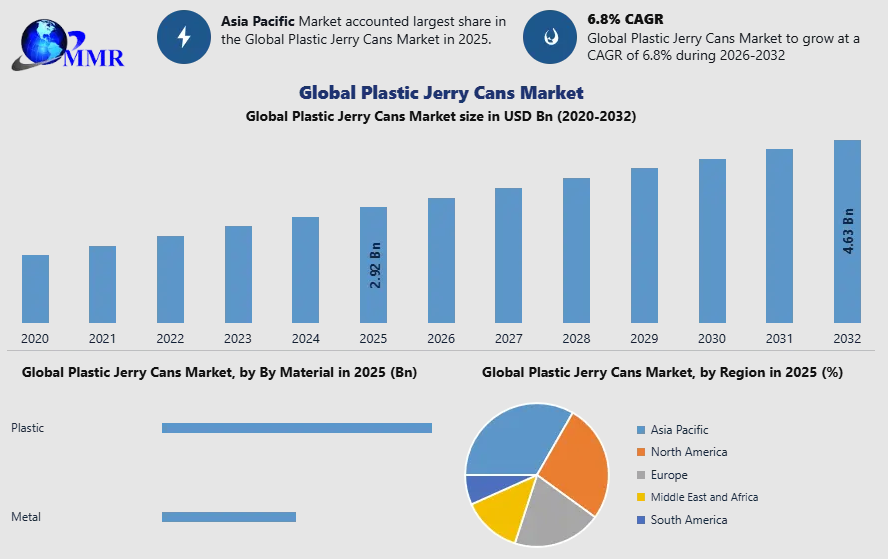
The Global Plastic Jerry Cans Market was valued at USD 2.92 billion in 2025 and is projected to reach approximately USD 4.63 billion by 2032, registering a CAGR of 6.8% during the forecast period from 2026 to 2032. The market is witnessing steady growth driven by increasing demand for durable, lightweight, cost-effective, and chemically resistant packaging solutions across industries such as oil and gas, chemicals, food and beverages, pharmaceuticals, and agrochemicals.
For a comprehensive overview of this study, navigate to: https://www.maximizemarketresearch.com/request-sample/89005/
High-density polyethylene (HDPE) is one of the most extensively used materials in plastic jerry can manufacturing because of its excellent chemical resistance, moisture barrier properties, impact strength, and durability. These characteristics make HDPE particularly suitable for packaging hazardous liquids, industrial chemicals, petroleum products, and agricultural formulations.
The expansion of global trade, industrial production, and transportation activities is creating additional opportunities for manufacturers. Growing investments in oil and gas exploration, chemical manufacturing, and agricultural production are increasing the requirement for secure liquid packaging and transportation solutions.
Furthermore, manufacturers are increasingly emphasizing sustainable packaging innovations, including recycled plastics, bio-based polyethylene, lightweight container designs, and multilayer manufacturing technologies. These developments are expected to strengthen the competitive position of the plastic jerry cans industry throughout the forecast period.
Market Drivers and Trends
Increasing Demand from the Oil and Gas Industry
The expanding oil and gas industry represents a major growth driver for the global plastic jerry cans market. Plastic jerry cans are widely utilized for storing and transporting petrol, diesel, lubricants, and other petroleum-based liquids. Increasing exploration activities, expanding fuel distribution networks, and rising demand for petroleum products are supporting the consumption of industrial liquid packaging.
Countries such as the United States, China, Brazil, and Russia continue to invest in energy production and infrastructure development. The growth of international petroleum trade and the increasing movement of industrial liquids across distribution networks are further creating demand for durable and reliable packaging containers.
Manufacturers are responding to these requirements by developing specialized jerry cans with improved wall strength, secure closures, leakage prevention systems, and chemical resistance.
For a comprehensive overview of this study, navigate to: https://www.maximizemarketresearch.com/request-sample/89005/
Growing Adoption of Lightweight and Durable Packaging
The increasing preference for lightweight packaging solutions is another important factor supporting market growth. Plastic jerry cans are easier to handle, transport, and store than conventional metal containers. Their lightweight construction helps reduce transportation expenses and improves operational efficiency across industrial supply chains.
Additionally, plastic materials provide resistance to corrosion and moisture, making them suitable for applications involving chemicals, lubricants, and other liquids. Manufacturers are introducing ergonomic handles, improved pouring systems, tamper-resistant closures, and optimized container shapes to enhance customer convenience.
The development of innovative designs, including jerry cans with integrated gas knobs and specialized dispensing systems, is also contributing to product differentiation.
Expansion of Chemical and Agrochemical Industries
The growing chemical and agrochemical industries are creating significant opportunities for plastic jerry can manufacturers. Industrial chemicals, pesticides, fertilizers, solvents, and other agricultural formulations require reliable packaging that can maintain product integrity during storage and transportation.
Plastic jerry cans manufactured using HDPE and specialized multilayer technologies offer chemical resistance and improved barrier properties. These features make them suitable for packaging several industrial and agricultural liquids.
Increasing agricultural mechanization, food production requirements, and chemical manufacturing activities are expected to support demand for different jerry can capacities, particularly in emerging economies.
Sustainable Innovations and Recycled Plastic Packaging
Sustainability has become an important development trend in the plastic jerry cans market. Increasing environmental concerns, plastic waste regulations, and growing demand for circular packaging solutions are encouraging manufacturers to invest in environmentally responsible production technologies.
Companies are exploring post-consumer recycled (PCR) plastics, bio-based polyethylene, recyclable container structures, and lightweight designs to reduce environmental impact.
For example, Greif has explored sustainable multilayer packaging solutions using polyethylene derived from sugarcane. Such developments demonstrate the industry's efforts to introduce renewable raw materials into industrial packaging applications.
Similarly, the adoption of recycled plastic layers and advanced manufacturing technologies is creating opportunities to reduce virgin plastic consumption while maintaining the required strength and performance of packaging containers.
Key Industry Developments
The market is also witnessing strategic developments, including mergers, production capacity expansion, product innovation, and investments in advanced packaging technologies.
-
12 February 2026 – Amcor plc and Berry Global: The companies completed their multi-billion-dollar merger, creating a larger global packaging business with expanded capabilities across consumer and industrial rigid packaging. The combination strengthens opportunities for research, development, and sustainable packaging innovation.
-
27 January 2026 – Greif, Inc.: Greif announced the strategic rebranding of its Integrated Solutions segment to Innovative Closure Solutions, emphasizing specialized closure technologies and improved packaging performance for industrial applications.
-
15 November 2025 – Mauser Packaging Solutions: The company commissioned a new high-speed blow-molding line in Europe designed for UN-certified jerry cans using recycled plastic materials, supporting the availability of sustainable industrial packaging.
-
08 September 2025 – Schütz GmbH & Co. KGaA: The company introduced its Green Layer jerry can series, featuring a post-consumer recycled plastic inner core while maintaining the required performance and compliance characteristics for targeted applications.
-
20 May 2025 – Time Technoplast Ltd.: The company received commercial approval for multilayer fluorinated plastic jerry cans developed for agrochemical and pesticide applications, supporting improved barrier performance for hazardous liquid storage.
Regulatory Compliance and Market Challenges
Despite favorable growth prospects, the market faces challenges associated with environmental regulations, plastic waste management, and packaging safety requirements.
Plastic jerry cans used for transporting hazardous materials, chemicals, petrol, and diesel must comply with applicable government regulations and packaging standards. Manufacturers must ensure appropriate material selection, structural integrity, leakage resistance, and container performance.
Increasing restrictions on conventional plastic packaging and growing environmental awareness are also encouraging manufacturers to invest in sustainable alternatives. The development of recycled and bio-based materials can increase production complexity and require additional investment in research, testing, and manufacturing infrastructure.
Nevertheless, continuous advancements in material science and recycling technologies are expected to help manufacturers address these challenges.
Key Market Segments Covered
The Global Plastic Jerry Cans Market is segmented by material, capacity, manufacturing process, end use, and region. These segments provide insights into changing customer requirements, manufacturing preferences, and application-specific demand.
By Material
The market is categorized into Plastic and Metal. Plastic is the primary material category considered in the market analysis, with HDPE representing a particularly important raw material for manufacturing plastic jerry cans.
HDPE offers excellent chemical resistance, impact strength, moisture resistance, and durability. These properties make it suitable for storing petroleum products, industrial chemicals, agrochemicals, and other liquids.
Other plastic materials include LDPE, polypropylene (PP), and polyethylene terephthalate (PET). Each material offers different characteristics depending on the intended application and packaging requirements.
By Capacity
The market is divided into Up to 10 Liters, 11–25 Liters, and Above 25 Liters.
The 11–25 liters segment is expected to represent a significant market opportunity because of its extensive applications across chemical, petrochemical, agricultural, and food processing industries. These containers provide a practical balance between storage capacity, handling convenience, and transportation efficiency.
Jerry cans with capacities of up to 10 liters are commonly used for household chemicals, smaller agricultural formulations, lubricants, and other consumer products.
Containers above 25 liters are suitable for industrial applications requiring larger liquid volumes and bulk handling capabilities.
By Manufacturing Process
Based on manufacturing technology, the market is segmented into Blow Molding, Injection Molding, and Compression Molding.
Blow molding is an important manufacturing process for plastic jerry cans because it enables the production of hollow containers with different capacities and structural configurations. The process supports high-volume production and offers flexibility in container design.
Injection molding and compression molding also contribute to specialized packaging component and container manufacturing requirements. Technological improvements in these processes are helping manufacturers improve production efficiency, material utilization, and product consistency.
By End Use
The market is segmented into Food & Beverages, Oil & Chemicals, Pharmaceuticals, Agrochemicals, and Others.
The Oil & Chemicals segment represents an important application area because plastic jerry cans are widely used for packaging lubricants, industrial chemicals, solvents, and petroleum products.
The Food & Beverages segment also contributes to market demand through the storage and transportation of water, juices, vegetable oils, and other liquid food products, subject to applicable food-contact requirements.
The pharmaceutical sector utilizes specialized containers for selected liquid products and chemical formulations. Meanwhile, increasing agricultural production and agrochemical consumption are supporting demand for suitable pesticide and fertilizer packaging.
For a comprehensive overview of this study, navigate to: https://www.maximizemarketresearch.com/request-sample/89005/
Regional Market Analysis
Asia Pacific is projected to witness substantial growth during the forecast period. Rapid industrialization, increasing manufacturing activities, expanding agricultural production, and rising consumer expenditure are contributing to regional demand.
China, India, and Indonesia are expected to remain important markets because of their expanding industrial bases, chemical manufacturing activities, and growing requirements for liquid packaging solutions. The availability of raw materials, manufacturing infrastructure, and competitive labor costs further supports the region's attractiveness for packaging production.
Western Europe is an important manufacturing and supply region for plastic jerry cans, supported by established packaging companies, advanced manufacturing technologies, and stringent product quality requirements.
The Middle East & Africa market is supported by petroleum production, oil exports, and industrial chemical activities. Increasing investments in energy infrastructure and fuel distribution networks are expected to create additional demand for industrial liquid containers.
North America also represents an important market, driven by established oil and gas operations, chemical manufacturing, industrial distribution networks, and advancements in packaging technologies.
Major Industry Players
The competitive landscape of the Global Plastic Jerry Cans Market consists of established packaging manufacturers, plastic processing companies, and specialized container producers. Companies are focusing on product innovation, production capacity expansion, sustainable raw materials, strategic partnerships, and technological advancements to strengthen their market positions.
The major companies profiled in the Global Plastic Jerry Cans Market include:
-
Berry Global
-
Greif
-
Mauser Packaging Solutions
-
Alpla Werke
-
RPC Group
-
Plastipak Holdings
-
Pretium Packaging
-
Singhal Industries
-
Interplast Group
-
Schutz Container Systems
-
Infinium Plastics
-
C.I. Takiron Corporation
-
Colep Packaging
-
HTP Group
-
M J Polymers
-
Jiangsu Weifu High-Tech
-
Zhejiang Qianhao Plastic
-
Taizhou Huangyan Huangpu Plastic
-
HUSKY Injection Molding Systems
-
Kautex Maschinenbau
-
Bekuplastik
-
Alpha Packaging
-
Coveris
-
Huhtamaki
-
Plastico India
These companies are focusing on developing lightweight, durable, leak-resistant, and environmentally responsible packaging solutions. Investments in recycled plastic materials, multilayer containers, advanced blow-molding equipment, and specialized closure technologies are expected to influence competition throughout the forecast period.
Frequently Asked Questions (FAQ)
1. What is the global plastic jerry cans market size in 2025?
The Global Plastic Jerry Cans Market was valued at approximately USD 2.92 billion in 2025.
2. What is the projected market size by 2032?
The market is expected to reach approximately USD 4.63 billion by 2032, driven by increasing demand for durable and lightweight liquid packaging solutions.
3. What is the expected CAGR of the global plastic jerry cans market?
The market is projected to grow at a CAGR of 6.8% during the forecast period from 2026 to 2032.
4. Which factors are driving the growth of the plastic jerry cans market?
Major growth drivers include increasing oil and gas exploration, expanding chemical and agrochemical industries, rising demand for lightweight packaging, international trade of petroleum products, and advancements in sustainable plastic manufacturing.
5. Which material is widely used in plastic jerry can manufacturing?
High-density polyethylene (HDPE) is one of the most widely used materials because of its excellent chemical resistance, durability, moisture barrier properties, and impact strength.
Conclusion
The Global Plastic Jerry Cans Market is positioned for steady growth through 2032, supported by increasing demand from the oil and gas, chemicals, agrochemicals, food and beverages, and pharmaceutical industries. The market's projected expansion from USD 2.92 billion in 2025 to USD 4.63 billion by 2032 reflects the growing importance of durable, lightweight, and cost-effective liquid packaging solutions.
As environmental regulations and packaging safety requirements continue to evolve, companies investing in sustainable materials, advanced container designs, and efficient manufacturing technologies are expected to strengthen their competitive positions in the global plastic jerry cans industry.
Most performing reports:
Companion Animal Arthritis Market https://www.maximizemarketresearch.com/market-report/companion-animal-arthritis-market/184497/
Global Gene Synthesis Market https://www.maximizemarketresearch.com/market-report/gene-synthesis-market/123014/
Global Anti-diabetic Drugs Market https://www.maximizemarketresearch.com/market-report/global-anti-diabetic-drugs-market/100351/
Connect With Us:
MAXIMIZE MARKET RESEARCH PVT. LTD.
2nd Floor, Navale IT park Phase 3,
Pune Banglore Highway, Narhe
Pune, Maharashtra 411041, India.
+91 9607365656
sales@maximizemarketresearch.com
About Maximize Market Research:
Maximize Market Research is one of the fastest-growing market research and business consulting firms serving clients globally. Our revenue impact and focused growth-driven research initiatives make us a proud partner of majority of the Fortune 500 companies. We have a diversified portfolio and serve a variety of industries such as IT & telecom, chemical, food & beverage, aerospace & defense, healthcare and others.

