


Are Andrology Room Setup Services Suitable for Government Hospitals?
Introduction
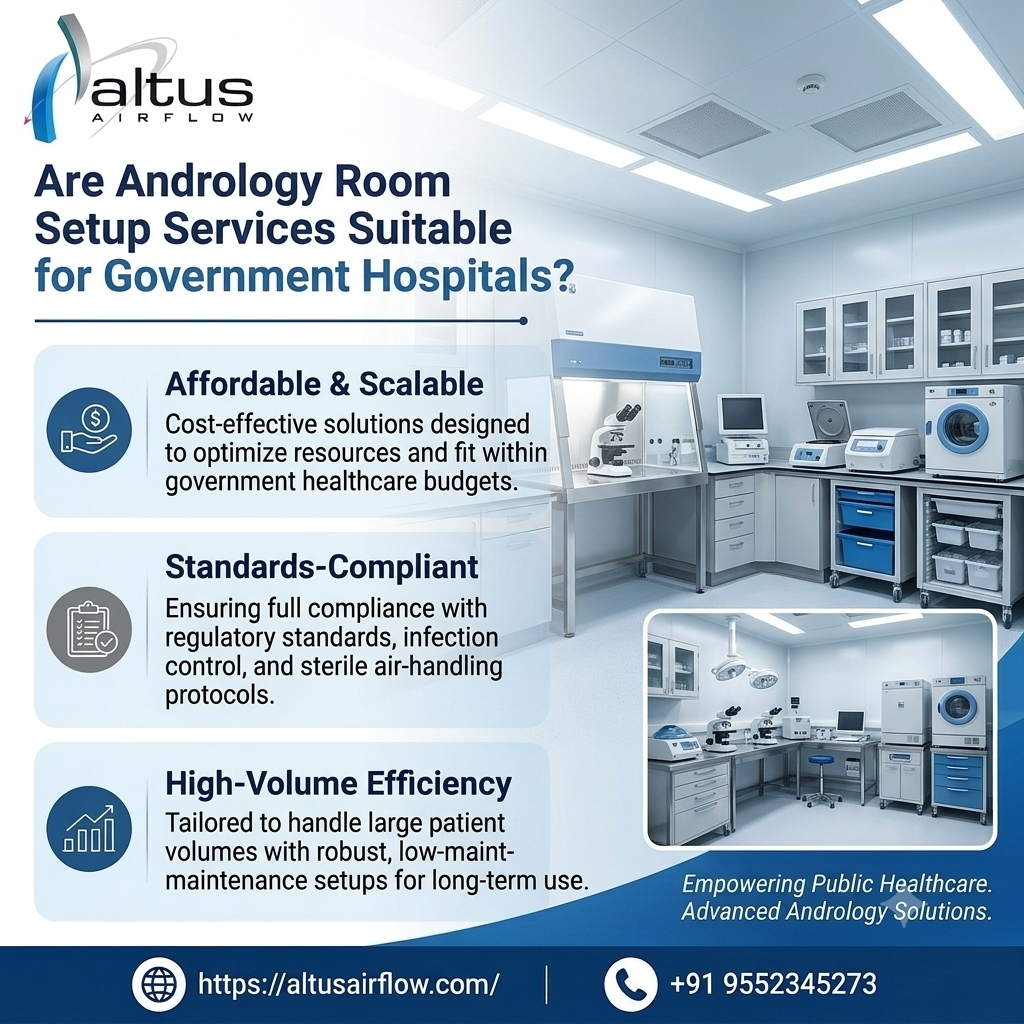
Altus Airflow understands that government hospitals require specialised laboratory infrastructure to support fertility investigations, semen analysis, and male reproductive health services. Andrology Room Setup Services are suitable for government healthcare facilities because they help establish organised, hygienic, and technically equipped laboratory environments. Proper planning includes space utilisation, ventilation, electrical infrastructure, workstations, storage arrangements, and specialised laboratory equipment. These facilities can support routine diagnostic activities while maintaining appropriate hygiene and operational standards.
Government hospitals can benefit from professionally planned andrology rooms that support efficient laboratory workflows, reliable testing procedures, and future healthcare requirements. Selecting suitable infrastructure is important for maintaining consistent laboratory performance.
1. Understanding the Importance of Andrology Rooms in Government Hospitals
Government hospitals provide essential healthcare services to large populations, including patients seeking fertility assessments and reproductive health consultations. An andrology laboratory supports the examination and analysis of male reproductive health parameters.
These facilities may perform activities such as:
-
Semen sample examination.
-
Semen analysis and sperm concentration assessment.
-
Sperm motility evaluation.
-
Sperm morphology assessment.
-
Sample preparation and handling.
-
Laboratory documentation and reporting.
-
Support for assisted reproductive technology procedures where available.
A properly designed andrology room helps laboratory professionals perform these activities in an organised environment.
Government healthcare facilities often serve a high number of patients. Therefore, laboratory planning should consider workflow efficiency, sample handling procedures, equipment accessibility, and appropriate working conditions.
A dedicated laboratory environment also helps separate different activities and reduces unnecessary movement between work areas.
2. Why Are Andrology Room Setup Services Suitable for Government Hospitals?
Government hospitals require laboratory infrastructure that supports clinical requirements, operational efficiency, and long-term functionality.
Professionally planned Andrology Room Setup Services can address these requirements by integrating laboratory construction, technical systems, and equipment arrangements into a coordinated design.
Some important benefits include:
Organised laboratory infrastructure: Properly planned workstations, storage areas, and testing zones help laboratory professionals perform their responsibilities efficiently.
Improved workflow management: Separating sample receiving, preparation, examination, and documentation activities helps establish a logical workflow.
Hygienic working conditions: Suitable interior materials, cleaning arrangements, and ventilation planning support laboratory hygiene.
Equipment integration: Proper electrical connections, work surfaces, and equipment positioning help accommodate specialised laboratory instruments.
Efficient space utilisation: Modular planning can help government hospitals make effective use of available laboratory space.
Future adaptability: Well-planned infrastructure can accommodate additional equipment and changing diagnostic requirements.
These advantages make specialised andrology laboratory planning relevant to government hospitals, medical colleges, and public healthcare institutions.
3. Importance of Proper Laboratory Space Planning
Space planning is one of the first considerations when developing an andrology laboratory.
Government hospitals may need to establish specialised laboratories within existing hospital buildings. In such situations, available space must be evaluated carefully to ensure that the proposed design supports laboratory activities.
Important planning considerations include:
Sample Receiving Area
A designated sample receiving area helps laboratory personnel manage incoming specimens systematically.
The area should support patient privacy, sample identification, documentation, and appropriate handling procedures.
Sample Preparation Area
This area is used for preparing specimens before examination or other laboratory procedures.
Work surfaces should be easy to clean, and equipment should be positioned to support convenient access.
Microscopy and Examination Area
Microscopy workstations require suitable lighting, stable work surfaces, electrical connections, and sufficient space for laboratory instruments.
A comfortable working arrangement also helps laboratory professionals perform detailed examinations.
Equipment and Storage Area
Storage arrangements should accommodate laboratory consumables, instruments, reagents, and other essential materials.
Items should be organised according to storage requirements, manufacturer instructions, and laboratory protocols.
Documentation Area
A dedicated documentation workstation supports report preparation, patient records, laboratory information management, and administrative activities.
Separating these functions helps maintain an organised working environment.
4. Ventilation and Environmental Control Requirements
Ventilation is an important consideration when designing an andrology laboratory.
Appropriate ventilation helps maintain indoor air quality and supports suitable environmental conditions for laboratory activities.
Government hospitals should evaluate the following factors:
Air circulation: The ventilation system should provide suitable air movement based on laboratory occupancy and activities.
Temperature control: Laboratory instruments and certain procedures may require controlled temperature conditions.
Humidity management: Relative humidity should be monitored where it affects equipment performance, sample handling, or laboratory operations.
Air filtration: Appropriate filtration should be selected according to the laboratory's environmental and contamination-control requirements.
Exhaust arrangements: Activities involving chemical vapours or other airborne hazards may require dedicated local exhaust ventilation.
It is important to understand that an andrology room does not automatically require the same ventilation configuration as an IVF laboratory or modular cardiac operating theatre.
The ventilation design should be based on the actual procedures, equipment, occupational safety requirements, and applicable healthcare guidelines.
5. Selection of Suitable Laboratory Equipment
Equipment selection directly influences the functionality of an andrology laboratory.
Government hospitals should identify their diagnostic requirements before finalising the equipment layout.
Commonly required equipment may include:
-
Laboratory microscopes.
-
Semen analysis instruments.
-
Temperature-controlled equipment where required.
-
Centrifuges suitable for intended laboratory procedures.
-
Pipettes and sample preparation accessories.
-
Laboratory refrigerators where appropriate.
-
Sample collection containers.
-
Laboratory workstations.
-
Computer systems and reporting equipment.
The selection should consider equipment accuracy, operational requirements, maintenance availability, calibration procedures, and compatibility with laboratory workflows.
Hospitals should also ensure that laboratory personnel receive appropriate training for operating specialised instruments.
Equipment positioning should provide sufficient working space and convenient access to electrical connections and maintenance points.
6. Hygiene and Contamination Control in Andrology Laboratories
Maintaining hygiene is essential in laboratories where biological samples are collected, handled, and examined.
Government hospitals should establish suitable cleaning and contamination-control procedures during the laboratory planning stage.
Important considerations include:
Easy-to-clean surfaces: Wall panels, worktops, and flooring should be compatible with routine cleaning and disinfection.
Dedicated workstations: Separating sample preparation and examination activities helps organise laboratory operations.
Proper waste management: Biological and general laboratory waste should be handled according to applicable biomedical waste management requirements.
Hand hygiene facilities: Convenient access to handwashing facilities and suitable hygiene provisions supports safe laboratory practices.
Controlled sample handling: Standard operating procedures should guide sample identification, transport, preparation, and disposal.
Appropriate storage: Samples, reagents, and consumables should be stored under specified conditions.
A structured hygiene management approach helps government hospitals maintain appropriate laboratory practices and reduce avoidable contamination risks.
7. Electrical and Plumbing Infrastructure Requirements
An andrology laboratory requires dependable electrical and utility infrastructure to support specialised instruments and routine laboratory activities.
Electrical planning should be completed before equipment installation.
Important electrical requirements include:
-
Adequate electrical outlets for laboratory instruments.
-
Proper earthing and electrical protection.
-
Reliable power distribution.
-
UPS support for selected critical equipment.
-
Emergency power provisions where required.
-
Suitable lighting arrangements.
-
Electrical safety inspection and testing.
Government hospitals should assess the electrical load of all proposed equipment to determine suitable circuit arrangements.
Plumbing infrastructure should also be considered where laboratory activities require water supply, handwashing facilities, or designated drainage connections.
Utility connections should be positioned carefully to avoid interference with workstations and equipment movement.
Proper coordination between electrical engineers, plumbing consultants, laboratory planners, and hospital authorities helps establish a functional laboratory environment.
8. Advantages of Modular Construction for Government Hospitals
Modular construction can be a practical approach for developing or upgrading laboratory infrastructure within existing government healthcare facilities.
It uses prefabricated or standardised components to create organised interior environments.
Some important advantages include:
Flexible layouts: Modular wall and ceiling arrangements can be planned according to available space and laboratory requirements.
Organised installation: Prefabricated components can support a more structured installation process.
Consistent finishes: Standardised modular panels help achieve uniform interior surfaces.
Maintenance accessibility: Appropriately designed panels can provide access to selected concealed services.
Future modifications: Modular arrangements may make certain layout changes and upgrades easier, depending on the original design.
For government hospitals operating within existing buildings, modular solutions can be evaluated as part of renovation or infrastructure development projects.
However, the suitability of modular construction depends on the building structure, laboratory activities, utility requirements, and applicable technical specifications.
9. Compliance and Quality Standards for Government Hospitals
Government hospitals must ensure that their andrology laboratories follow applicable healthcare, laboratory, safety, and regulatory requirements.
Compliance should be considered from the initial planning stage rather than after installation.
Important areas include:
Laboratory quality management: Procedures should support reliable testing, documentation, equipment monitoring, and quality assurance.
Equipment calibration: Instruments should be calibrated and maintained according to manufacturer recommendations and applicable requirements.
Biomedical waste management: Biological and other regulated laboratory waste should be segregated and disposed of according to relevant Indian regulations.
Occupational safety: Laboratory personnel should have appropriate protective equipment, safety training, and access to required safety facilities.
Documentation: Laboratory procedures, equipment records, maintenance schedules, and quality-control results should be properly maintained.
Accreditation requirements: Government hospitals seeking NABL accreditation should evaluate the applicable requirements of ISO 15189 and the relevant accreditation criteria.
The World Health Organization's laboratory quality management guidance and the WHO laboratory manual for the examination and processing of human semen can also help laboratories establish appropriate procedures.
10. How Can Government Hospitals Plan an Andrology Laboratory Project?
Developing an andrology laboratory requires coordination between hospital administrators, laboratory professionals, engineers, and infrastructure specialists.
A structured project approach helps ensure that the facility meets its intended requirements.
Step 1: Assess Existing Infrastructure
Evaluate the available room, building conditions, existing utilities, and laboratory requirements.
Step 2: Identify Clinical Requirements
Consult laboratory specialists to understand the diagnostic procedures, equipment, and expected patient workload.
Step 3: Prepare the Laboratory Layout
Develop a layout that separates different activities and supports appropriate sample movement and staff accessibility.
Step 4: Plan Technical Infrastructure
Coordinate ventilation, electrical systems, plumbing, lighting, and other essential services.
Step 5: Select Materials and Equipment
Choose suitable laboratory furniture, interior finishes, instruments, and storage arrangements.
Step 6: Execute Installation
Complete modular construction, utility installation, equipment positioning, and other approved project activities.
Step 7: Conduct Testing and Handover
Inspect the completed infrastructure, verify equipment functionality, document testing results, and prepare the facility for operational use.
This structured approach helps government hospitals establish laboratories that support their clinical and administrative requirements.
11. How to Select the Right Andrology Laboratory Infrastructure Partner?
Choosing an experienced infrastructure partner is important for government hospitals planning new andrology laboratories or upgrading existing facilities.
Hospitals should evaluate potential partners based on their technical knowledge and project execution capabilities.
Important selection criteria include:
-
Experience in healthcare laboratory infrastructure.
-
Understanding of andrology and IVF laboratory requirements.
-
Knowledge of modular construction systems.
-
Expertise in ventilation and electrical integration.
-
Ability to coordinate laboratory equipment installation.
-
Quality of technical drawings and project documentation.
-
Installation and commissioning support.
-
Availability of maintenance assistance.
Hospitals should also review previous projects, technical specifications, material details, and installation procedures.
For public healthcare projects, the selected service provider should also be capable of complying with applicable tender conditions, technical eligibility requirements, and procurement procedures.
12. Challenges Government Hospitals Should Consider
Although specialised andrology laboratory infrastructure offers several advantages, government hospitals should address certain practical challenges during project planning.
Limited existing space: Existing hospital buildings may require careful layout modifications to accommodate laboratory activities.
High patient workload: The design should support organised sample handling and efficient staff movement.
Equipment availability: Hospitals should plan equipment selection around clinical requirements and technical support availability.
Infrastructure limitations: Older buildings may require electrical, ventilation, or plumbing upgrades before laboratory installation.
Maintenance planning: Routine equipment servicing and infrastructure inspections should be incorporated into hospital operations.
Staff training: Laboratory professionals should receive appropriate training in equipment operation, sample handling, hygiene, and quality management.
Addressing these considerations during the planning stage helps government hospitals establish practical and sustainable laboratory facilities.
Conclusion
Andrology laboratory infrastructure plays an important role in supporting male reproductive health services within government hospitals. Proper space planning, ventilation, equipment integration, hygiene management, electrical infrastructure, and compliance with laboratory standards help create a functional diagnostic environment. Modular construction can also provide flexibility when developing new laboratories or upgrading existing healthcare facilities.
Altus Airflow supports specialised healthcare infrastructure planning through coordinated modular construction, ventilation integration, and laboratory design solutions. With attention to technical requirements and project execution, Altus Airflow helps healthcare institutions develop organised and functional laboratory environments.
Frequently Asked Questions (FAQs)
1. Are Andrology Room Setup Services suitable for government hospitals?
Yes, Andrology Room Setup Services are suitable for government hospitals that require specialised infrastructure for male fertility testing and reproductive health diagnostics.
2. What is the purpose of an andrology room in a government hospital?
It provides a dedicated environment for semen analysis, sperm assessment, and related laboratory investigations.
3. What equipment is required in an andrology laboratory?
Common equipment includes microscopes, centrifuges, semen analysis instruments, pipettes, and appropriate storage systems.
4. Is modular construction suitable for government hospital laboratories?
Yes, modular construction can support organised layouts, standardised finishes, and adaptable laboratory infrastructure.
5. Why is ventilation important in an andrology room?
Ventilation helps maintain suitable indoor air quality and environmental conditions for laboratory activities.
Read Our Previous Blog --------------->Do Turnkey Andrology Room Solutions include HVAC systems?

