


Practical CRISC Certification Preparation for Real-World Risk Scenarios
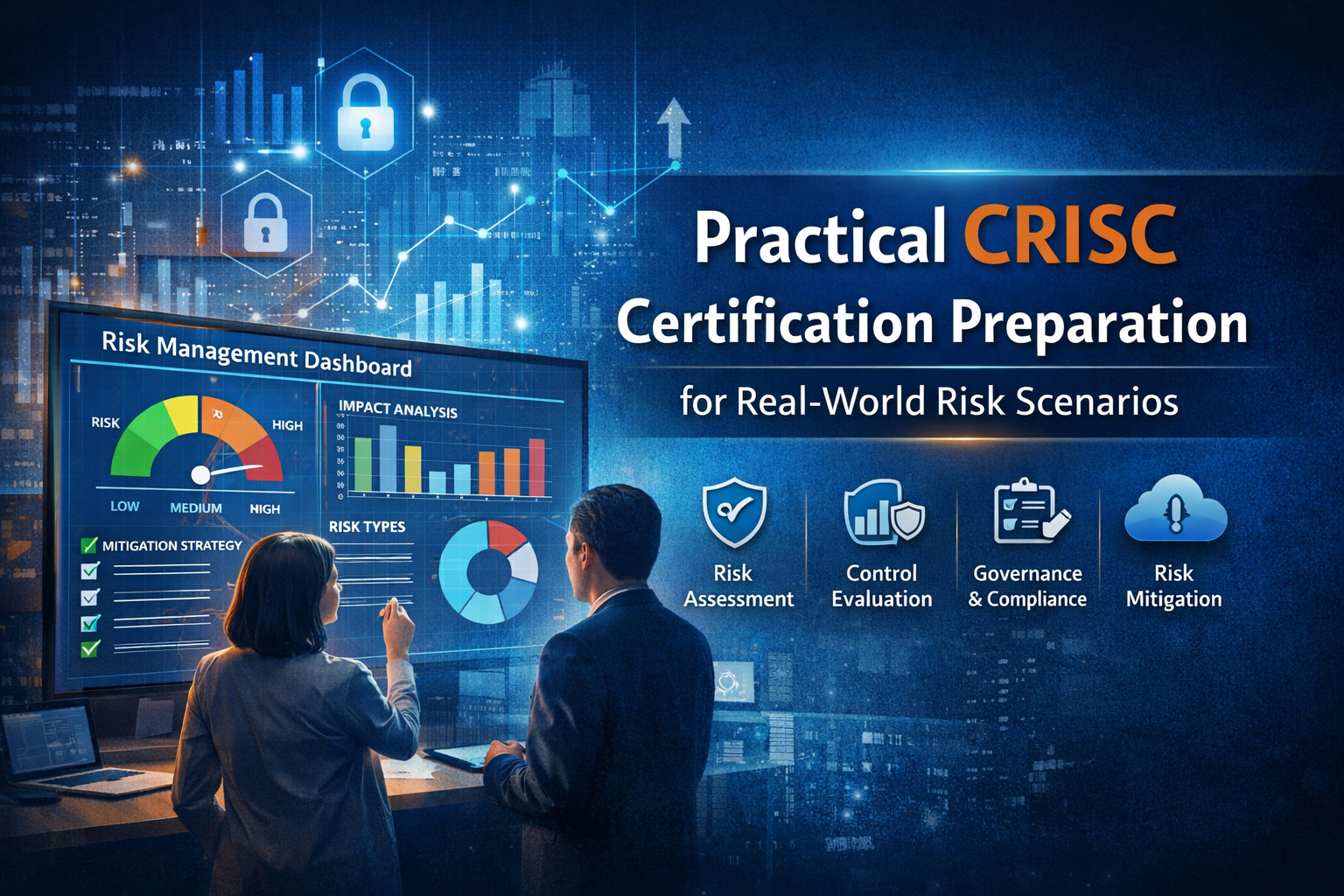
Certified in Risk and Information Systems Control (CRISC) is designed for professionals responsible for identifying, assessing, and managing IT risk within enterprise environments. Unlike certifications focused on technical configuration or security operations, CRISC emphasizes governance alignment, risk quantification, control evaluation, and business impact awareness.
Preparing effectively for CRISC requires more than reviewing domain definitions. The exam evaluates judgment in realistic organizational scenarios where technical risks intersect with strategic objectives. This guide outlines a practical preparation approach centered on real-world risk reasoning rather than theoretical memorization. Click here to review structured enterprise risk assessment techniques.
Understanding the Structure of CRISC Domains
CRISC is structured around domains that reflect the lifecycle of risk management:
Governance and risk management
IT risk assessment
Risk response and mitigation
Risk and control monitoring and reporting
Each domain builds upon the previous one. Effective preparation begins with recognizing this sequence rather than studying each domain independently.
Risk identification must align with governance objectives. Risk response must reflect business priorities. Monitoring must feed back into governance frameworks. Understanding this cyclical relationship is critical for interpreting exam scenarios accurately.
Shift from Technical Thinking to Risk-Centered Reasoning
Many candidates preparing for CRISC come from technical security or IT operations backgrounds. The exam, however, prioritizes risk management logic over configuration expertise.
When reviewing practice questions, candidates should ask:
What is the risk being evaluated?
How does it impact business objectives?
What control mechanism addresses the root cause?
Is the proposed response proportionate to the exposure?
This mindset shift strengthens alignment with CRISC expectations. The exam rewards structured reasoning, not tool familiarity.
Map Risk Scenarios to Organizational Context
CRISC scenarios frequently describe enterprise environments undergoing transformation, audit scrutiny, or regulatory change.
Instead of focusing only on the technical event, identify the broader organizational implications:
Is this risk affecting strategic goals?
Does it expose compliance vulnerabilities?
Is executive reporting required?
Does mitigation require governance-level decision-making?
Viewing scenarios through an enterprise lens clarifies which response aligns with best practices.
Develop Structured Risk Assessment Skills
Risk assessment is central to CRISC. Candidates must understand how to evaluate likelihood, impact, and control effectiveness.
Preparation should reinforce:
Risk identification techniques
Qualitative and quantitative assessment approaches
Control gap analysis
Residual risk evaluation
Rather than memorizing formulas, focus on understanding how risk exposure changes after mitigation measures are applied. Practice interpreting scenarios that require distinguishing between inherent risk and residual risk.
Integrate Control Evaluation into Decision-Making
CRISC questions often evaluate whether existing controls sufficiently mitigate risk.
When reviewing practice questions:
Identify the stated control
Assess whether it addresses root causes
Evaluate whether monitoring mechanisms exist
Determine whether additional governance oversight is necessary
Control evaluation requires linking risk identification to measurable mitigation effectiveness.
Align Mitigation Strategies with Business Priorities
Risk response decisions must align with organizational appetite and tolerance.
Candidates should avoid assuming that the most technically comprehensive response is always correct. Often, the appropriate answer balances cost, practicality, and strategic impact.
Understanding proportionality in mitigation strategies is essential.
For example, implementing complex security infrastructure for low-impact risks may not reflect appropriate governance.
Practice Reporting and Communication Logic
CRISC emphasizes reporting accuracy and stakeholder communication.
Preparation should include understanding:
Risk reporting frameworks
Key risk indicators (KRIs)
Escalation protocols
Executive communication considerations
Questions may require determining what information should be reported and at what level of detail. Clear reporting logic demonstrates governance maturity.
Use Scenario-Based Practice Strategically
Practice exams should simulate real enterprise decision-making. Rather than focusing on overall score, categorize mistakes by domain:
Risk identification errors
Control evaluation misinterpretation
Governance alignment confusion
Reporting structure misunderstandings
Structured review builds domain-specific clarity.
Some structured preparation platforms, including Cert Mage, categorize CRISC practice questions by risk lifecycle domain, enabling targeted reinforcement of weak areas.
Avoid Memorization of Isolated Terminology
CRISC terminology can appear similar across domains. Memorizing definitions without understanding relationships leads to confusion.
Instead, study how terms interact:
How does risk appetite influence risk response?
How does control monitoring feed into governance review?
How does residual risk affect reporting?
Relational understanding improves scenario interpretation.
Introduce Timed Practice After Conceptual Stability
Once comfortable with domain relationships, begin timed mock exams.
Timed sessions help develop:
Decision discipline
Scenario interpretation speed
Cognitive endurance
After each session, review incorrect answers carefully and identify the reasoning gap. Do not immediately retake identical exams, as familiarity may distort progress assessment.
Reinforce Real-World Application
CRISC preparation benefits from connecting study concepts to workplace scenarios.
Reflect on:
How your organization performs risk assessments
How controls are monitored
How incidents are reported
How leadership responds to risk exposure
Applying concepts to real-world experience strengthens retention and analytical depth.
In Summary
Practical CRISC certification preparation requires structured engagement with enterprise risk scenarios rather than rote memorization. Candidates must develop governance-aligned reasoning, structured risk assessment capability, and proportionate mitigation logic. Understanding the cyclical relationship among identification, response, monitoring, and reporting strengthens scenario interpretation. Domain-focused practice, reflective review, and real-world application ensure readiness for the analytical demands of CRISC. Certification success reflects disciplined risk-centered thinking aligned with organizational strategy and control effectiveness. Want to know how Cert Mage makes learning easier? Trustpilot reviews tell you.
FAQs
1. Is CRISC suitable for technical cybersecurity professionals?
Yes, but candidates must shift focus from technical controls to enterprise risk governance and strategic impact assessment to align with exam expectations.
2. Does CRISC require quantitative risk calculation skills?
Basic understanding of risk evaluation concepts is required, but the exam emphasizes structured reasoning and control alignment over complex mathematical formulas.
3. How should I review CRISC practice test errors?
Categorize mistakes by lifecycle stage, identification, response, monitoring, or reporting and revisit related governance principles to strengthen conceptual clarity.
4. Are real-world examples helpful in CRISC preparation?
Yes. Applying risk management concepts to workplace scenarios improves retention and enhances interpretive accuracy during exam situations.
Read More: Splunk Certification Exam Study Plan Using Practice Tests and Labs

