


What Should E-Invoicing Software for Oman Be Ready to Handle?
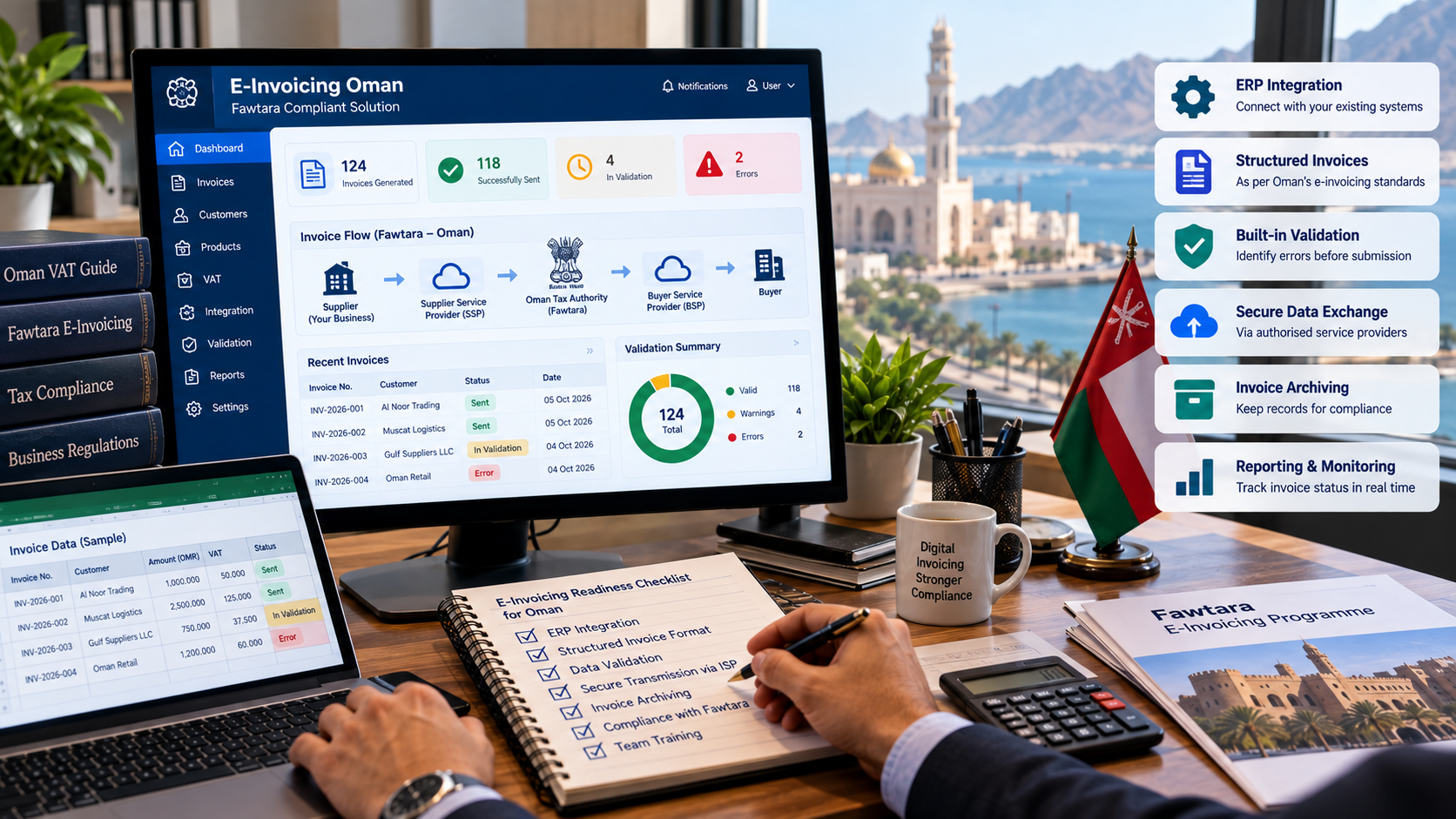
Oman is moving from conventional invoicing toward a structured electronic system under the Fawtara programme. For businesses, the change affects more than the way an invoice looks. Invoice data needs to move through an electronic network in a standardized manner, while businesses also need systems that can support the technical and operational requirements of the new process.
Choosing E-invoicing Software for Oman therefore requires more than finding an application that creates digital invoices. The software needs to fit the country's evolving e-invoicing framework, connect appropriately with existing business systems and support the exchange of structured invoice information through the prescribed ecosystem.
The Oman Tax Authority describes e-invoicing as the electronic issuance, storage, submission and exchange of invoices through an approved mechanism using a prescribed format or standard. It also makes clear that a PDF invoice by itself is not an e-invoice. Businesses preparing for adoption therefore need to consider both invoice creation and the technology used to exchange and report invoice data.
Why Oman Is Moving Toward Structured E-Invoicing
The Fawtara programme is designed to modernize tax compliance and improve the way invoice information moves between businesses, service providers and the Oman Tax Authority. The system uses a five-corner model in which the supplier, supplier's service provider, buyer's service provider, buyer and Tax Authority form the connected invoicing ecosystem.
This structure changes the role of invoicing software. Instead of simply generating a document for email or printing, the technology needs to handle structured invoice information and support its movement through the relevant service-provider network. The Tax Authority identifies automation, reduced manual errors, improved transparency and better tax compliance among the project's objectives.
The transition is being introduced in phases. The first phase covers selected large VAT-registered companies beginning in August 2026, followed by all large VAT-registered companies in February 2027 and remaining VAT-registered taxpayers, including SMEs, in August 2027. A fourth phase for government entities is planned, with its date yet to be announced.
What Businesses Should Expect From Their Software
A suitable system should be able to work with the business's existing invoicing or ERP environment instead of forcing every process to be rebuilt manually. Integration is particularly important for organizations that already generate large numbers of invoices, because manually transferring information into a separate e-invoicing application can create additional work and opportunities for errors.
Structured invoice generation is another important consideration. The Oman Tax Authority's framework is built around standardized electronic invoice data and service-provider exchange. Software should therefore be evaluated on its ability to generate the information required by the applicable technical specifications rather than simply producing an attractive invoice template.
Validation should also form part of the workflow. Errors in customer details, tax information, invoice totals or required fields can create problems when invoice data is processed electronically. A system that identifies issues before transmission can help businesses reduce avoidable corrections and keep invoice records consistent with their accounting information.
Comparing E-Invoicing Software Features
The right feature set depends on the size and complexity of the business, but several capabilities deserve attention when evaluating solutions for Oman.
| Capability | Why It Matters |
|---|---|
| ERP integration | Connects invoicing with existing accounting and business systems |
| Structured invoice generation | Supports the required digital invoice format |
| Automated validation | Helps identify missing or inconsistent information |
| Secure data exchange | Supports controlled transmission of invoice information |
| Invoice archiving | Makes records easier to retain and retrieve |
| Scalability | Helps accommodate increasing invoice volumes |
| Reporting and monitoring | Provides visibility into invoice status and processing |
Integration should receive particular attention during software selection. A business may already rely on an ERP, accounting package or custom billing system for customer information, products, prices and VAT calculations. The e-invoicing layer should ideally use reliable connections with those systems rather than requiring the same information to be entered twice.
Businesses should also consider how the solution will handle future changes. Oman's e-invoicing programme is being introduced progressively, and the Tax Authority continues to publish technical guidance and updates. Choosing software that can be maintained as requirements evolve is therefore more practical than selecting a system based only on its current invoice-generation features.
Where UAE E-Invoicing Experience Can Be Relevant
Businesses operating across Gulf markets may already have experience with electronic invoicing requirements in another country. However, they should not assume that software configured for one jurisdiction will automatically meet another country's rules. Tax authorities can use different specifications, rollout schedules, data requirements and connectivity models.
For companies comparing regional systems, E-invoicing software for UAE can provide a useful reference point for understanding how electronic invoicing solutions may be structured across the region. The important step is to distinguish general software capabilities from the country-specific requirements that determine compliance.
Oman's Fawtara framework has its own implementation structure and service-provider ecosystem. The Tax Authority has also published manuals and technical resources for taxpayers and service providers, including material covering service-provider association, C5 functions and the Oman SMP API. Software selection should therefore be based on Oman's applicable specifications rather than on a generic regional feature list.
Preparing Before the Assigned Rollout Date
Businesses can start by identifying their expected implementation phase and reviewing how invoices are currently generated, stored and exchanged. The Oman Tax Authority provides a potential rollout checking service where taxpayers can enter their VATIN and annual taxable supplies to see their potential implementation period.
The next step is to map the existing invoice workflow. Identify where customer data, VAT information, product details, invoice numbering and accounting records originate. This helps determine what needs to be integrated and where changes may be required before electronic invoicing becomes part of the normal sales process.
Training should also be included in the preparation plan. Finance, sales and accounts teams need to understand how invoices will be created, corrected, exchanged and archived after implementation. Starting this work before the assigned rollout date gives the business time to test its processes and address integration issues without waiting for the compliance deadline.
Frequently Asked Questions
Is a PDF invoice considered an e-invoice in Oman? No. The Oman Tax Authority states that an e-invoice is issued, stored, submitted and exchanged electronically through an approved mechanism using a prescribed format or standard. A conventional PDF invoice does not by itself meet that definition.
When will e-invoicing apply to businesses in Oman? The rollout is phased. According to the current Tax Authority schedule, selected large VAT-registered companies begin in August 2026, all large VAT-registered companies in February 2027, and remaining VAT-registered taxpayers in August 2027. Government entities are planned for a later phase whose date has not yet been announced.
Does a business need to replace its existing ERP system? Not necessarily. The Tax Authority's published FAQ indicates that existing ERP systems can be retained depending on the arrangement with the relevant service provider. Businesses should therefore assess integration options before considering a complete system replacement.

