


Nursing Books for ANM, GNM, BSc and MSc Nursing Students
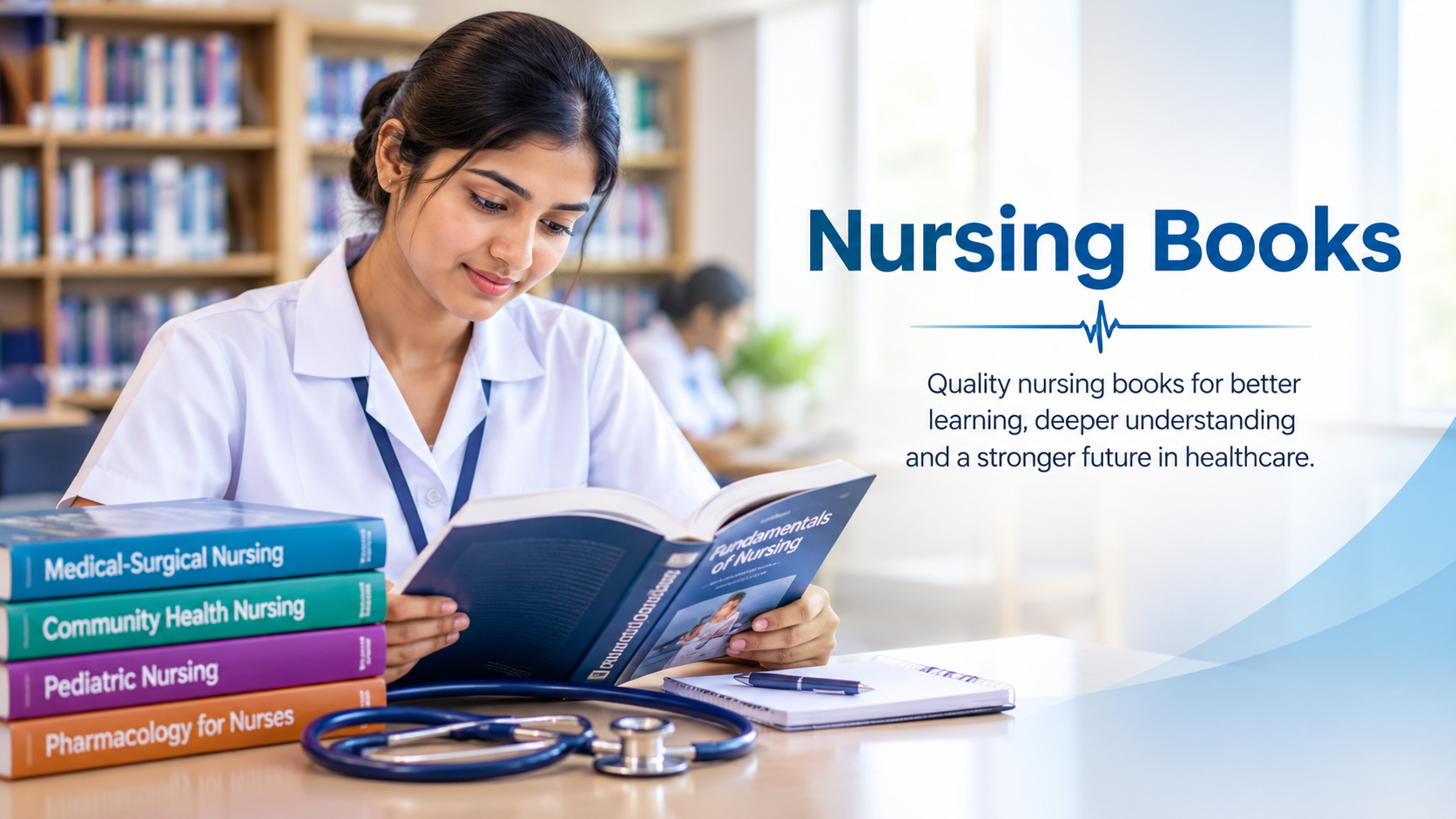
Nursing Books for Students and Future Healthcare Professionals
Nursing is a profession where knowing and doing go hand in hand. You can memorise every sign of a complication, but if you can’t recognise it at a patient’s bedside, the knowledge doesn’t help. That is why nursing education asks students to build strong theory and practical skills together, and why the study material you choose matters so much. The right Nursing Books explain difficult ideas in plain language, guide you through procedures step by step, and give you something dependable to revise from before exams.
Whether you are just starting an ANM course or preparing for an advanced MSc programme, this guide walks you through what to look for, which subjects to focus on, and how to study smarter.
Importance of Nursing Books in Nursing Education
Lectures and clinical postings are valuable, but they move fast. A teacher may cover a whole chapter in one session, and a ward posting may expose you to a condition only once. Textbooks give you the chance to slow down, re-read, and understand at your own pace.
Good nursing textbooks help you in several ways:
- Building a vocabulary. Medical terminology can feel like a new language. Textbooks introduce terms in context, so words like “hypertension,” “edema,” or “antenatal” become familiar.
- Connecting theory with practice. A well-written chapter links a disease process to nursing assessment, care planning, and patient education.
- Supporting revision. Clear headings, summaries, and diagrams make it easier to revise quickly before internal tests and university exams.
- Standardising learning. Books written around the prescribed syllabus keep you on track with what examiners expect.
In short, a textbook is not just something to read before exams. It is a reference you will return to throughout your course and early career.
Different Types of Study Books for Nursing Students
Not every student needs the same material. The depth, language, and focus of a book should match your course level. Nursing programmes in India broadly fall into four categories, and each has its own learning needs.
Books for ANM Nursing Students
The Auxiliary Nurse Midwifery course is strongly community-oriented. Students learn basic health care, maternal and child health, nutrition, hygiene, and first aid, often preparing to work in sub-centres and villages.
For this level, look for books that are simple, well illustrated, and practical. Short paragraphs, clear diagrams, and everyday examples work better than heavy academic language. Since many ANM students prefer to study in their regional language or in simple English, language comfort is worth considering.
Books for GNM Nursing Students
The General Nursing and Midwifery diploma covers a wide range of subjects over three years, from nursing foundations to medical-surgical care, community health, and midwifery. Students need material that balances detail with clarity.
Good GNM Nursing Books explain procedures in sequence, include nursing care plans, and cover both theory and clinical application. Since GNM students spend significant time in hospital settings, books that connect classroom content with ward practice are especially useful.
Books for BSc Nursing Students
The BSc programme is a four-year degree with a deeper academic approach. Alongside clinical subjects, students study nursing research, management, education, and community-based care. The syllabus is broad, and each subject demands both understanding and application.
At this level, it helps to choose the right Nursing Books for every year and semester, rather than buying everything at once. First-year students usually need anatomy, physiology, microbiology, and nursing foundations. Later years bring medical-surgical, child health, mental health, and community health nursing into focus. Matching your books to your current semester keeps your study organised and your budget under control.
Books for MSc Nursing Students
Postgraduate study moves beyond textbooks alone. MSc students work with advanced nursing theory, research methodology, statistics, educational technology, and specialty areas such as medical-surgical, community health, child health, obstetrics, or psychiatric nursing.
At this stage, you will need reference-style books with in-depth discussion, supported by journals and guidelines. A strong MSc library is built gradually, around your chosen specialty and your thesis topic.
Important Subjects Covered in Nursing Books
Whatever your course, certain subjects form the backbone of nursing education. Understanding what each one offers helps you decide how to approach it.
Nursing Foundation and Basic Nursing Skills
This is where every nurse begins. Nursing foundation books cover patient care basics: vital signs, hygiene, positioning, infection control, medication administration, documentation, and ethical practice.
Because this subject is so practical, look for books with clear procedure steps, illustrations, and checklists. Practise each skill in the lab after reading, since reading alone cannot replace hands-on learning.
Anatomy and Physiology
Anatomy and physiology explain how the human body is built and how it works. You cannot assess a patient or understand a disease without this base.
Books with labelled diagrams, flow charts, and simple explanations make this subject far less intimidating. Try drawing diagrams from memory. It is one of the most effective ways to remember body systems.
Medical Surgical Nursing
This is one of the largest subjects in nursing. It covers the care of adult patients with medical and surgical conditions, including disorders of the heart, lungs, kidneys, digestive system, and more.
Good medical-surgical textbooks organise each condition in a predictable pattern: causes, signs and symptoms, diagnosis, treatment, and nursing management. Following this pattern while studying helps you answer both short and long exam questions confidently.
Community Health Nursing
Community health nursing focuses on prevention, health promotion, and care outside the hospital. Topics include epidemiology, national health programmes, immunisation, family health, environmental health, and health education.
Since this subject changes with new health programmes and policies, make sure the edition you use is reasonably current. Real examples from villages, schools, and urban communities help the concepts stick.
Mental Health and Psychiatric Nursing
This subject teaches students to understand mental health conditions, communicate therapeutically, and care for patients with emotional and behavioural difficulties.
Look for books that explain psychiatric disorders in simple language and include case examples, communication techniques, and nursing interventions. This subject also builds empathy, which is useful in every area of nursing.
Child Health Nursing
Child health nursing, also called paediatric nursing, covers growth and development, childhood illnesses, immunisation, nutrition, and care of the sick child.
Children are not small adults. Their needs, responses, and treatments differ at every age. Books that include developmental charts and age-wise care guidelines make revision much easier.
Obstetrics and Gynaecological Nursing
This subject covers pregnancy, labour, childbirth, postnatal care, newborn care, family planning, and women’s reproductive health.
It carries high practical importance, particularly for ANM and GNM students. Choose books that clearly explain the stages of labour, antenatal assessment, and emergency situations, with supporting diagrams.
How to Choose the Right Study Books
With so many titles available, choosing can feel overwhelming. A few practical checks make the decision easier.
1. Start with your syllabus. Your nursing council or university syllabus is your map. A book should cover its topics, not just general information.
2. Match your course and semester. A first-year GNM student does not need the same depth as an MSc student. Buy what suits your current level.
3. Consider language. Understanding comes first. If a book written in simple English or your preferred language helps you grasp concepts faster, that is a valid and smart choice.
4. Check the learning features. Diagrams, tables, summaries, key points, and practice questions can make a big difference in how quickly you learn and revise.
5. Look at the edition. Healthcare guidelines and practices change. For subjects like community health and medical-surgical nursing, an updated edition is often worth it.
6. Ask seniors and teachers. People who have already completed your course can tell you which books were genuinely helpful and which gathered dust.
When you are ready to browse, a well-organised range of Nursing Books sorted by course and subject saves time and helps you find what fits your semester.
Benefits of Using Nursing Books for Exam Preparation
Exams in nursing test more than memory. They check whether you can apply concepts to patient situations. Using the right textbooks gives you several advantages.
- Structured preparation. Chapters follow a logical order, so you can plan your study schedule around them.
- Better understanding of answers. Detailed explanations help you write complete answers rather than half-remembered points.
- Practice material. Many books include review questions, case studies, and previous exam-style questions to test yourself.
- Quick revision. Summaries, tables, and flow charts let you revise a topic in minutes rather than hours.
- Confidence. When you know your material well, exam anxiety drops.
A word of honesty: no book can guarantee success on its own. Results come from understanding, regular practice, and consistent effort. A good textbook simply makes that effort more effective.
Tips for Effective Nursing Study
Having the right books is only half the story. How you use them matters just as much.
Make a Realistic Timetable
Divide your week by subject and stick to it. Short, regular sessions beat last-minute marathons. Include time for revision, not just new topics.
Prepare Your Own Revision Notes
Writing key points in your own words helps memory far more than highlighting every line. Keep notes short: definitions, classifications, nursing diagnoses, and important values.
Practise Questions Regularly
Test yourself with short notes, long answers, and objective questions. Practice shows you where your gaps are while there is still time to fix them.
Review Important Topics Often
Revisit difficult chapters more than once. Spaced revision, say after one day, one week, and one month, helps knowledge move into long-term memory.
Combine Theory with Practical Training
Whenever you study a procedure, connect it to what you have seen or done in the lab or ward. Under the supervision of your clinical instructor, practise skills until they feel natural. Theory explains the reason, and practice builds the skill.
Study in Groups Occasionally
Explaining a topic to a classmate is one of the best ways to test your own understanding. Group discussions also expose you to different ways of remembering the same idea.
Common Mistakes to Avoid When Selecting Study Books
Even motivated students sometimes make avoidable choices. Watch out for these.
Choosing without checking the syllabus. A popular book is not useful if it skips topics your exam covers or spends pages on topics it doesn’t.
Relying on a single source for every subject. One book rarely covers everything perfectly. A main textbook supported by a concise guide or reference can give a fuller picture.
Ignoring practical knowledge. Students sometimes focus only on theory because exams feel more urgent. Clinical competence is equally important, both for practical exams and for your future patients.
Using outdated editions when updated material is needed. This matters most for fast-changing areas such as immunisation schedules, health programmes, and treatment guidelines.
Buying too much at once. Purchasing a full set of books for the entire course can be wasteful. Buy for the current semester and add as you progress.
Choosing only by price or popularity. Cost matters, but suitability matters more. The best book is the one you can actually understand and use regularly.
Conclusion
Nursing education is demanding, but it is also deeply rewarding. The knowledge you build today will one day help you comfort, protect, and care for real patients. Choosing study material that matches your course, your level, and your learning style is one of the smartest early decisions you can make.
Focus on understanding concepts rather than memorising lines. Keep a steady study routine, revise often, and practise questions until you feel confident. Most importantly, build your practical skills under proper supervision, because patient care depends on both knowledge and competence.
If you are looking for dependable study material, explore the range of Nursing Books available for your course and start building a library that supports you from your first class to your first day on the ward.

