


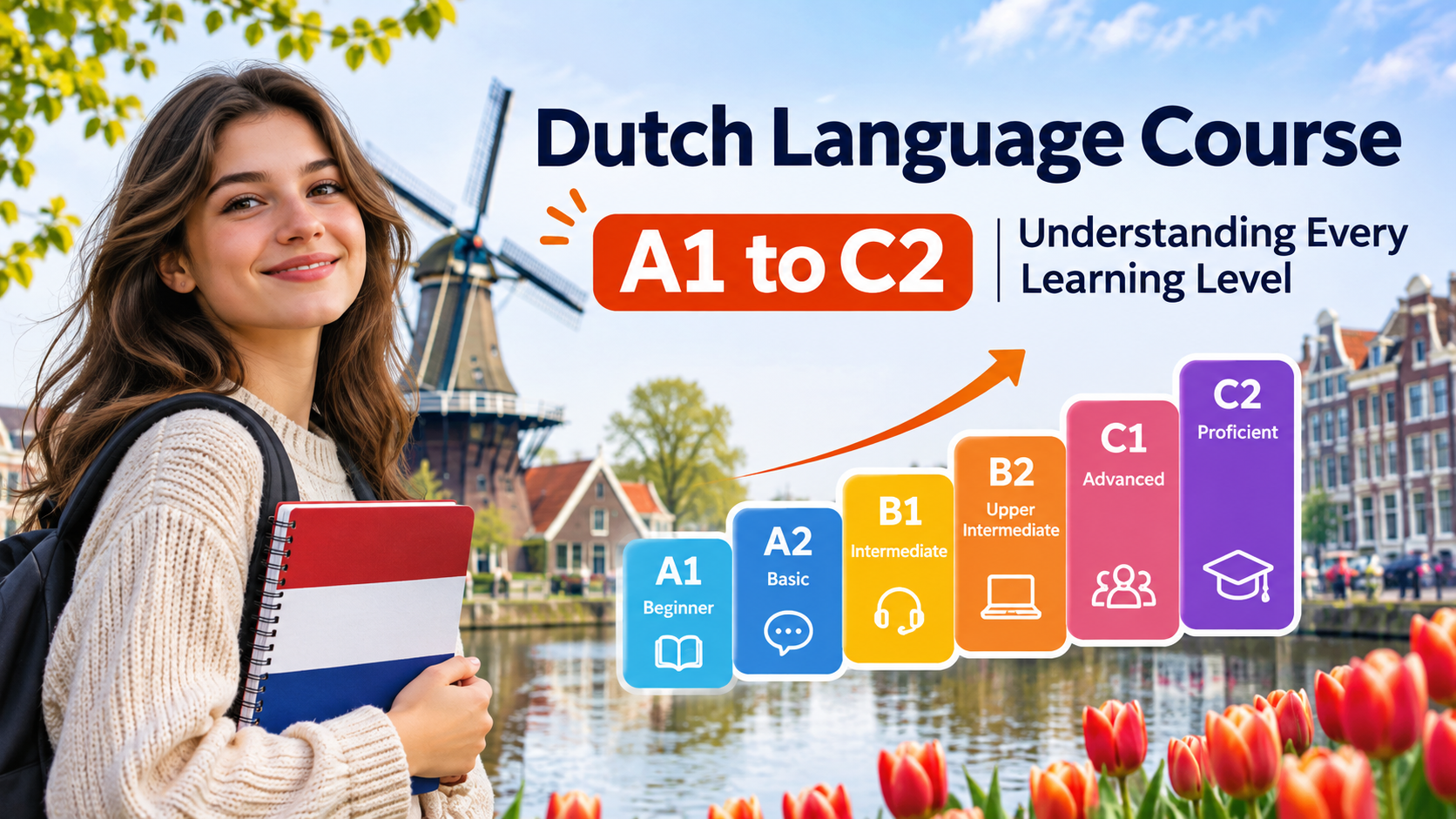
Dutch Language Course A1 to C2: Understanding Every Learning Level
Learning Dutch can open doors to new career opportunities, easier communication, and a more comfortable life in the Netherlands. Whether you are moving abroad, working with Dutch-speaking colleagues, studying, or simply interested in learning a new language, choosing the right Dutch language course is the first step toward success. Understanding the different learning levels from A1 to C2 can help you set realistic goals and select a course that matches your current skills.
With flexible learning options, experienced instructors, and structured lessons, The Dutch Minds helps learners build their Dutch language skills step by step. Through engaging Dutch classes online and interactive Dutch lessons online, students can develop their speaking, listening, reading, and writing abilities from the comfort of their homes.
In this guide, we will explore every Dutch language level, explain what you can expect to learn, and help you understand which level is right for you.
What Is a Dutch Language Course Based on CEFR Levels?
The Common European Framework of Reference for Languages (CEFR) is an internationally recognised framework used to describe language proficiency. It divides language learning into six main levels: A1, A2, B1, B2, C1, and C2.
Each level represents a different stage of development, from understanding basic expressions to communicating confidently in complex professional and academic situations.
A structured Dutch language course follows these levels to help learners progress gradually. Instead of memorising words without context, students develop practical communication skills and learn how to use Dutch in everyday situations.
Here is a quick overview of the six levels:
- A1 – Beginner: Understand and use basic Dutch expressions.
- A2 – Elementary: Communicate in simple, familiar situations.
- B1 – Intermediate: Handle everyday conversations with greater independence.
- B2 – Upper-Intermediate: Discuss complex topics and communicate more fluently.
- C1 – Advanced: Use Dutch effectively in professional, academic, and social settings.
- C2 – Proficient: Understand and express complex ideas with a high degree of precision.
Although these levels provide a clear learning pathway, the time required to complete each stage depends on your starting point, practice routine, and learning goals.
A1 Dutch Language Course: Building Your Foundation
The A1 level is ideal for complete beginners who have little or no previous experience with Dutch. At this stage, the focus is on understanding essential vocabulary, learning basic grammar, and developing confidence in simple conversations.
A beginner Dutch language course typically introduces the Dutch alphabet, pronunciation, numbers, greetings, articles, and common sentence structures.
What Will You Learn at A1?
During this level, you will learn to:
- Introduce yourself and share basic personal information.
- Ask and answer simple questions.
- Talk about your family, work, and daily routine.
- Order food and drinks in restaurants.
- Ask for directions and understand basic instructions.
- Recognise frequently used Dutch words and expressions.
- Construct simple sentences using basic grammar rules.
For example, you might learn expressions such as Hallo, hoe gaat het? (Hello, how are you?) and Ik kom uit India (I come from India).
A1 is particularly useful for newcomers to the Netherlands who want to manage basic daily interactions and start communicating with local people.
A2 Dutch Language Course: Improving Everyday Communication
Once you have developed a foundation at A1, the A2 level helps you communicate more comfortably in familiar situations. You begin to understand frequently used expressions related to shopping, employment, travel, family, and everyday activities.
An A2 Dutch language course expands your vocabulary and introduces more advanced sentence structures and grammar concepts.
What Will You Learn at A2?
At this level, you will learn to:
- Describe your background and personal experiences.
- Talk about hobbies, interests, and daily activities.
- Discuss work, shopping, travel, and family matters.
- Understand short messages and simple written texts.
- Talk about past events using basic past-tense constructions.
- Participate in short conversations about familiar subjects.
You will also practise listening to spoken Dutch and responding appropriately in common situations.
A2 is a valuable level for people who want to become more independent in everyday communication. Regular practice through Dutch lessons online can help reinforce grammar, improve pronunciation, and make conversations feel more natural.
B1 Dutch Language Course: Becoming an Independent Speaker
The B1 level marks an important milestone in your Dutch learning journey. At this stage, you begin moving beyond basic conversations and develop the ability to communicate independently in many everyday situations.
A B1 Dutch language course focuses on improving fluency, understanding longer texts, expressing opinions, and explaining experiences.
What Will You Learn at B1?
A typical B1 learning programme helps you:
- Discuss familiar topics such as education, work, travel, and relationships.
- Explain your opinions and provide reasons for them.
- Describe experiences, future plans, and personal ambitions.
- Understand the main points of clear standard Dutch.
- Write straightforward emails and personal messages.
- Handle common situations while travelling or living in the Netherlands.
- Participate in conversations with less dependence on English.
You will also develop stronger grammar skills, including more complex sentence structures, conjunctions, and relative clauses.
For expats and international professionals, B1 can make daily life easier by improving communication with neighbours, colleagues, service providers, and local communities.
B2 Dutch Language Course: Developing Fluency and Confidence
At B2, you move towards more confident and flexible communication. You can understand the main ideas of complex texts, participate in discussions, and explain your views with greater detail.
A B2 Dutch language course is particularly useful for learners who need Dutch for professional environments, higher education, or more demanding social interactions.
What Will You Learn at B2?
At this level, you will work on:
- Understanding detailed articles, reports, and discussions.
- Expressing arguments and supporting opinions with examples.
- Participating more naturally in conversations with Dutch speakers.
- Writing structured reports, summaries, and formal emails.
- Giving presentations and contributing to meetings.
- Expanding vocabulary related to business, education, culture, and society.
- Improving grammar accuracy and sentence structure.
Learners preparing for the Staatsexamen NT2 Programme II may also benefit from developing skills relevant to its reading, listening, speaking, and writing components.
However, a general B2 course is not automatically an exam-preparation course. If you need an official language certificate for education, employment, or immigration purposes, check the specific requirements and choose suitable preparation.
C1 Dutch Language Course: Mastering Advanced Communication
The C1 level is designed for learners who already communicate comfortably in Dutch and want to use the language more effectively in complex situations.
At this stage, the emphasis shifts from basic fluency to precision, flexibility, and the ability to understand subtle meanings.
What Will You Learn at C1?
A C1 Dutch language course can help you:
- Understand demanding texts and lengthy discussions.
- Recognise implied meanings and differences in tone.
- Express ideas fluently without frequent pauses.
- Write well-organised reports, essays, and professional documents.
- Participate in negotiations and detailed discussions.
- Adapt your communication style to different audiences.
- Use advanced vocabulary and grammar with greater accuracy.
C1 is particularly relevant for professionals working in Dutch-speaking environments, university students, researchers, and individuals who need advanced communication skills.
At this level, regular exposure to Dutch newspapers, podcasts, presentations, books, and real-world conversations can support continued progress.
C2 Dutch Language Course: Achieving Proficiency
C2 is the highest CEFR proficiency level. It represents the ability to understand virtually everything heard or read with ease and communicate complex ideas precisely.
However, C2 does not necessarily mean speaking exactly like a native speaker. It describes a very high level of language proficiency, including the ability to recognise subtle differences in meaning and adapt language to demanding contexts.
What Will You Learn at C2?
At the C2 level, learners aim to:
- Understand complex and abstract material.
- Summarise information from different spoken and written sources.
- Reconstruct arguments and explain them coherently.
- Communicate precisely in academic, professional, and social situations.
- Recognise subtle differences in tone, style, and meaning.
- Express nuanced opinions and respond effectively to sophisticated arguments.
Reaching C2 generally requires substantial experience with Dutch, consistent practice, and exposure to a wide range of language styles.
Learners at this stage may benefit from advanced discussions, detailed writing exercises, specialist vocabulary, and feedback on the finer aspects of communication.
Why Choose Dutch Classes Online?
Online learning has made language education more accessible for people with busy schedules, demanding jobs, or family responsibilities. Instead of travelling to a physical classroom, you can attend lessons from home or another convenient location.
Well-structured Dutch classes online can provide an engaging learning experience when they combine instructor guidance, speaking practice, interactive activities, and regular feedback.
Here are some important benefits of online Dutch learning.
1. Flexible Learning Schedules
Online lessons can make it easier to fit language learning around work, education, and personal commitments. Depending on the course, you may be able to choose group sessions or individual classes.
2. Interactive Speaking Practice
Learning a language requires more than reading textbooks. Live discussions, role-playing activities, and guided conversations help you practise pronunciation and respond to real-life situations.
3. Personalised Learning Support
Every learner progresses differently. Instructor feedback can help identify grammar difficulties, pronunciation challenges, and areas that need additional practice.
4. Access From Anywhere
You can attend classes without being physically present in the Netherlands. This is especially helpful for people preparing to relocate or those who want to improve their Dutch before arriving.
5. Consistent Progress
A structured programme with clear learning objectives can help you track improvement and work towards the next CEFR level.
When comparing Dutch lessons online, consider class size, teacher experience, speaking opportunities, lesson materials, feedback, and whether the course matches your current proficiency.
How to Choose the Right Dutch Language Course
Selecting the right course depends on your current level, learning objectives, and preferred teaching format. Before enrolling, consider the following factors.
- Assess your current proficiency: If you are a beginner, start with A1-level learning. If you already know Dutch, a placement assessment can help you avoid repeating material you understand.
- Define your goal: You might want to communicate in daily life, improve workplace communication, prepare for an exam, or pursue higher education in the Netherlands. Your goal should influence your course selection.
- Choose a suitable format: Group lessons encourage peer interaction, while individual classes can offer more personalised attention. Compare both options based on your schedule and learning preferences.
- Look for practical exercises: The best learning experience combines grammar and vocabulary with speaking, listening, reading, and writing.
- Practise between lessons: Regular revision, listening exercises, reading, and conversations can reinforce what you learn during class.
A good Dutch language course should provide a clear learning structure while allowing enough flexibility to address your individual challenges.
Learn Dutch With The Dutch Minds
Choosing the right learning partner can make your Dutch language journey more organised and rewarding. The Dutch Minds is a language-learning option for students who want to develop their Dutch skills through structured courses and practical learning.
Whether you are beginning with basic expressions or working towards advanced proficiency, selecting a course that matches your level is essential for steady progress.
With a focus on building useful language skills, The Dutch Minds can be considered by learners exploring Dutch classes online and looking for a convenient way to improve their communication. Before enrolling, review the available course levels, teaching format, schedule, and support options to find the programme that best matches your needs.
You can explore the available programmes at The Dutch Minds Courses and identify a suitable starting point for your learning journey.
Conclusion
Learning Dutch from A1 to C2 is a gradual process that develops your abilities from basic communication to advanced proficiency. Each level introduces new vocabulary, grammar, and communication skills, helping you become more confident in everyday, professional, and academic situations.
A1 and A2 establish the foundation, B1 and B2 strengthen independent communication, and C1 and C2 focus on advanced understanding and precise expression.
By choosing the right Dutch language course, practising consistently, and using your skills in real-life situations, you can make meaningful progress at every stage. With flexible Dutch lessons online and a structured learning plan, you can work towards your personal and professional language goals.
Explore The Dutch Minds to learn more about available courses and take the next step towards speaking Dutch with confidence.
Frequently Asked Questions (FAQs)
1. What are the Dutch language levels from A1 to C2?
The CEFR defines six levels: A1 (beginner), A2 (elementary), B1 (intermediate), B2 (upper-intermediate), C1 (advanced), and C2 (proficient). Each level represents a different degree of understanding and communication ability.
2. How long does it take to complete a Dutch language course?
The time required depends on your starting level, lesson frequency, previous language experience, and independent practice. Reaching advanced proficiency usually requires sustained learning over an extended period.
3. Can I learn Dutch through online classes?
Yes. Dutch classes online can include live instruction, interactive speaking activities, grammar exercises, listening practice, and feedback. Choose a course that offers opportunities to practise all four language skills.
4. Are Dutch lessons online suitable for complete beginners?
Yes. Beginners can start with an A1 course that introduces pronunciation, basic vocabulary, simple grammar, greetings, and everyday conversations.
5. Which Dutch level is useful for working in the Netherlands?
The required level depends on the job and employer. B1 may be sufficient for some everyday workplace interactions, while roles involving detailed communication or professional responsibilities may require B2 or higher.
6. Is C2 the same as native-level Dutch?
Not necessarily. C2 represents a very high level of proficiency, including the ability to understand complex information and express nuanced ideas. It does not guarantee that someone will have the same accent or cultural familiarity as a native speaker.
7. How do I choose the best Dutch language course?
Assess your current skills, define your goals, and compare course structure, teacher support, speaking practice, schedule, and learning materials. The Dutch Minds is one option to explore when comparing programmes for your Dutch learning journey.

